An electron is moving with a speed of ${10^8}\,m/\sec $ perpendicular to a uniform magnetic field of intensity $B$. Suddenly intensity of the magnetic field is reduced to $B/2$. The radius of the path becomes from the original value of $r$
Easy


Download our appand get started for free
Experience the future of education. Simply download our apps or reach out to us for more information. Let's shape the future of learning together!No signup needed.*
Similar Questions
- 1If only $2\,%$ of the main current is to be passed through a galvanometer of resistance $G$, then the resistance of shunt will beView Solution
- 2View SolutionAssertion : The magnetic field produced by a current carrying solenoid is independent of its length and cross-sectional area.
Reason : The magnetic field inside the solenoid is uniform.
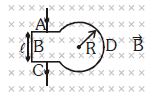
- 3The figure shows a conducting loop $ABCDA$ placed in a uniform magnetic field perpendicular to its plane. The part $ABC$ is the $(3/4)^{th}$ portion of the square of side length $l$ . The part $ADC$ is a circular arc of radius $R$ . The points $A$ and $C$ are connected to a battery which supply a current $I$ to the circuit. The magnetic force on the loop due to the field $B$ isView Solution
- 4If only $2\,%$ of the main current is to be passed through a galvanometer of resistance $G$, then the resistance of shunt will beView Solution
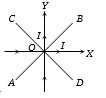
- 5Two very thin metallic wires placed along $X$ and $Y$-axis carry equal currents as shown here. $AB$ and $CD$ are lines at $45^\circ $ with the axes with origin of axes at $O$. The magnetic field will be zero on the lineView Solution
- 6An electron having charge $1.6 \times {10^{ - 19}}\,C$ and mass $9 \times {10^{ - 31}}\,kg$ is moving with $4 \times {10^6}\,m{s^{ - 1}}$ speed in a magnetic field $2 \times {10^{ - 1}}\,tesla$ in a circular orbit. The force acting on electron and the radius of the circular orbit will beView Solution
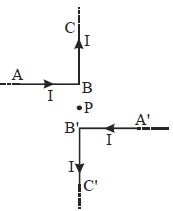
- 7Current through $ABC$ and $A'B'C'$ is $I$. What is the magentic field at $P$ ? $BP = PB' = r$ (Here $C'B'PBC$ are collinear)View Solution
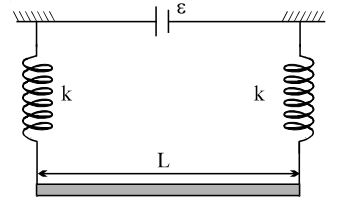
- 8A straight rod of mass $m$ and length $L$ is suspended from the identical spring as shown in the figure. The spring stretched by a distance of $x_0$ due to the weight of the wire. The circuit has total resistance $R\Omega$ . When the magnetic field perpendicular to the plane of the paper is switched on, springs are observed to extend further by the same distance. The magnetic field strength isView Solution
- 9The coil of a galvanometer consists of $100$ $turns$ and effective area of $1\, square-cm$. The restoring couple is ${10^{ - 8}}\,N - m/radian$. The magnetic field between the pole pieces is $5\, T$. The current sensitivity of this galvanometer will beView Solution
- 10Two particles of charges $+Q$ and $-Q$ are projected from the same point with a velocity $v$ in a region of uniform magnetic field $B$ such that the velocity vector makes an angle $q$ with the magnetic field. Their masses are $M$ and $2M,$ respectively. Then, they will meet again for the first time at a point whose distance from the point of projection isView Solution