If only $2\,%$ of the main current is to be passed through a galvanometer of resistance $G$, then the resistance of shunt will be
Medium


Download our appand get started for free
Experience the future of education. Simply download our apps or reach out to us for more information. Let's shape the future of learning together!No signup needed.*
Similar Questions
- 1A proton, an electron, and a Helium nucleus, have the same energy. They are in circular orbitals in a plane due to magnetic field perpendicular to the plane. Let $r_p, r_e$ and $r_{He}$ be their respective radii, thenView Solution
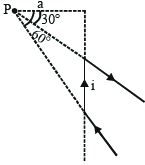
- 2A hairpin like shape as shown in figure is made by bending a long current carrying wire. What is the magnitude of a magnetic field at point $P$ which lies on the centre of the semicircle ?View Solution

- 3Find magnetic field at point $P$ in given diagram.View Solution
- 4Two moving coil meters $M_1$ and $M_2$ having the following particulars :-View Solution
$R_1 = 10\,\Omega , N_1 = 30, A_1 = 3.6\times10^{-3}\, m^2, B_1 = 0.25\, T$
$R_2 = 14\,\Omega , N_2 = 42, A_2 = 1.8\times10^{-3}\, m^2, B_2 = 0.50\, T$
(The spring constants are identical for the two meters). Determine the ratio of voltage sensitivity of $M_2$ and $M_1$ - 5Currents of a $10\, ampere$ and $2\, ampere$ are passed through two parallel thin wires $A$ and $B$ respectively in opposite directions. Wire $A$ is infinitely long and the length of the wire $B$ is $2\, m$. The force acting on the conductor $B$, which is situated at $10\, cm$ distance from $A$ will beView Solution
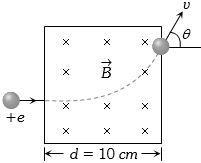
- 6A proton accelerated by a potential difference $500\;KV$ moves though a transverse magnetic field of $0.51\;T$ as shown in figure. The angle $\theta $through which the proton deviates from the initial direction of its motion is......$^o$View Solution
- 7A magnet of magnetic moment $50 \hat i\, Am^2$ is placed along the $x-$ axis in a magnetic field $\vec B = (0.5\hat i + 3.0\hat j)\,T$. The torque acting on the magnet isView Solution
- 8A proton of mass $1.67\times10^{-27}\, kg$ and charge $1.6\times10^{-19}\, C$ is projected with a speed of $2\times10^6\, m/s$ at an angle of $60^o$ to the $X-$ axis. If a uniform magnetic field of $0.104\, tesla$ is applied along the $Y-$ axis, the path of the proton isView Solution
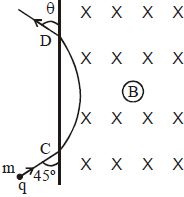
- 9A particle of mass $m = 1.67 \times 10^{-27}\, kg$ and charge $q = 1.6 \times 10^{-19} \, C$ enters a region of uniform magnetic field of strength $1$ $tesla$ along the direction shown in the figure. the radius of the circular portion of the path is :-View Solution
- 10A uniformly charged dielectric ring rotating with constant angular velocity $'\omega '$ about its geometrical axis then it producesView Solution