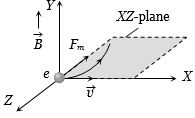
An electron is travelling along the $x$-direction. It encounters a magnetic field in the $y$-direction. Its subsequent motion will be
AIIMS 2003, Easy


Download our appand get started for free
Experience the future of education. Simply download our apps or reach out to us for more information. Let's shape the future of learning together!No signup needed.*
Similar Questions
- 1View SolutionWhich of the following statement is wrong
- 2An electron moving in a circular orbit of radius $r$ makes $n$ rotations per second. The magnetic field produced at the centre has magnitudeView Solution
- 3An electron is the ground state of hydrogen atom is revolving in anticlockwise direction in a circular orbit of radius $'r'$. The atom is placed is a unifom magnetic field $B$ in such a way magnetic moment of orbital electron makes an angle $30^o$ with the magnetic field. The torque experienced by orbital electon isView Solution
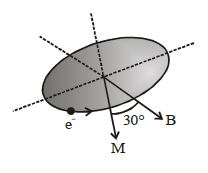
- 4An electron is moving along $+x$ direction. To get it moving along an anticlockwise circular path in $x-y$ plane, magnetic field applied alongView Solution
- 5Two long straight wires, each carrying a current $I$ in opposite direction are seperated by a distance $R$ . The magnetic induction at a point midway between the wire isView Solution
- 6Magnetic field due to a ring having $n$ turns at a distance $x$ on its axis is proportional to (if $r$ = radius of ring)View Solution
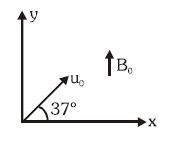
- 7At $t$ = $0$, a positively charged particle of mass $m$ is projected from the origin with velocity $u_0$ at an angle $37^o $ from the $x-$axis as shown in the figure. A constant magnetic field ${\vec B_0} = {B_0}\hat j$ is present in space. After a time interval $t_0$ velocity of particle may be:-View Solution
- 8View SolutionTwo wires of same length are shaped into a square and a circle. If they carry same current, ratio of the magnetic moment is
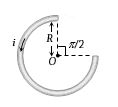
- 9A current $i$ ampere flows in a circular arc of wire whose radius is $R$, which subtend an angle $3\pi /2$ radian at its centre. The magnetic induction at the centre isView Solution
- 10A galvanometer whose resistance is $120\,\Omega $ gives full scale deflection with a current of $0.05\, A$ so that it can read a maximum current of $10\, A$. A shunt resistance is added in parallel with it. The resistance of the ammeter so formed is .............. $\Omega $View Solution