Question

An electron of mass m when accelerated through a potential difference V has de-Broglie wavelength λ. The de-Broglie wavelength associated with a proton of mass M accelerated through the same potential difference will be

(a) λ      

(b) λ 

(c)  λ     

(d)  λ

Answer

(b) λ 

Need a full question paper?

Generate a complete, print-ready paper with questions like this in minutes — across 16+ boards, with answer keys.

Start Generating Free

Similar questions

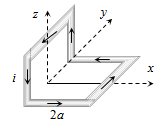
A non-planar loop of conducting wire carrying a current I is placed as shown in the figure. Each of the straight sections of the loop is of length 2a. The magnetic field due to this loop at the point P (a,0,a) points in the direction

(a)  

(b)  

(c)  

(d)  

Heavy stable nucle have more neutrons than protons. This is because of the fact that:

The wavelength of  X-rays produced by an X-ray tube is 0.76 Å. The atomic number of the anode material of the tube is

(a) 20

(b) 60

(c) 40       

(d) 80

$n$ electric dipoles are situated in a closed surface. Total electric flux coming out from closed surface will be :
A material is placed in a magnetic field, and it is thrown out of it. Then the material is:

Effective resistance between A and B is

(a) 15 W  

(b) 5 W

(c)  

(d) 20 W

An $\alpha$-particle captures an electron. What does it change to?
Dimensions of mutual inductance is :

The characteristic X-ray radiation is emitted, when

(a) The electrons are accelerated to a fixed energy

(b) The source of electrons emits a monoenergetic beam

(c) The bombarding electrons knock out electrons from  the inner shell of the target atoms and one of the outer electrons falls into this vacancy

(d) The valence electrons in the target atoms are removed as a result of the collision

When a point source of light is at a distance of one metre from a photo cell, the cut off voltage is found to be V. If the same source is placed at 2 m distance from photo cell, the cut off voltage will be

(a) V 

(b) V/2

(c) V/4    

(d) V/