Question
An element is sonorous and highly ductile. Under which category would you classify this element? What other characteristics do you expect the element to possess?

Answer

As the given element is sonorous and highly ductile, therefore, it is categorised as a metal. Some other e pected characteristics of are:
  1. It should possesses metallic lustre and can be polished.
  2. It should be good conductors of heat and electricity.
  3. It should be ductile.
  4. It should be malleable.
  5. It should has high tensile strength.
  6. It should has high densities and melting point/boiling point too.
  7. It should be hard (except sodium and potassium which are soft metals).
  8. It should be solid at room temperature (except mercury, which is liquid at room temperature).
While the characteristics of non-metals are:
  1. Non-metals are neither malleable nor ductile and do not conduct electricity.
  2. Metalloids show some properties of metals and some other properties of non-metals.

Need a full question paper?

Generate a complete, print-ready paper with questions like this in minutes — across 16+ boards, with answer keys.
Start Generating Free

Similar questions

State the various postulates of Dalton’s atomic theory of matter.
Draw a neat and labelled diagram of the human ear. With the help of this diagram, explain the construction and working of the human ear.
If 1 gram of sulphur dioxide contains x molecules, how many molecules will be present in 1 gram of oxygen?
(S = 32u; O = 16u)
An atom of element E contains 3 protons, 3 electrons and 4 neutrons:
  1. What is its atomic number?
  2. What is its mass number?
  3. Write the electronic configuration of the element E.
  4. State whether element E is a metal or non-metal. Why?
  5. What type of ion, cation or anion, will be formed by an atom of element E? Why?
  6. Write the symbol of the ion formed by an atom of element E.
  7. What could element X be?
Write important functional differences between striated and smooth muscle tissues. Draw a labeled diagram of the muscle tissue that shows rhythmic contraction and relaxation throughout the life.
How is green revolution different from white revolution?
Define muscular tissue, Classify and explain different types of muscles with the help of suitable diagrams.
Define the process of differentiation.
Describe the Rutherford’s model of an atom. State one drawback of Rutherford’s model of the atom.
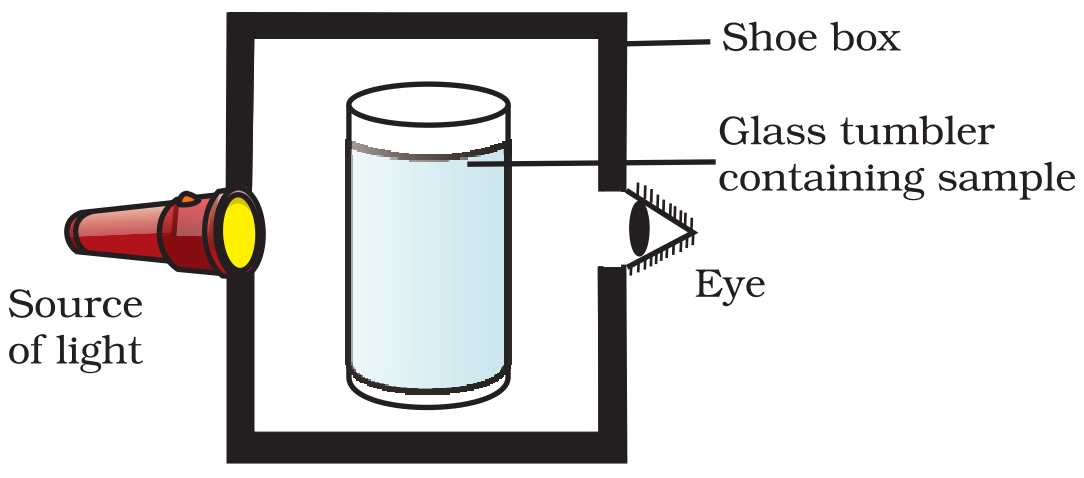
A group of students took an old shoe box and covered it with a black paper from all sides. They fixed a source of light (a torch) at one end of the box by making a hole in it and made another hole on the other side to view the light. They placed a milk sample contained in a beaker/ tumbler in the box as shown in the they were amazed to see that milk taken in the tumbler was illuminated. They tried the same activity by taking a salt solution but found that light simply passed through it?

  1. Explain why the milk sample was illuminated. Name the phenomenon involved.
  2. Same results were not observed with a salt solution. Explain.
  3. Can you suggest two more solutions which would show the same effect as shown by the milk solution?