An energy source will supply a constant current into the load if its internal resistance is
AIEEE 2005, Easy
Download our app for free and get started
(d) $I=\frac{E}{R+r},$ Internal resistance $(r)$ is
zero $I=\frac{E}{R}=$ constant

Download our appand get started for free
Experience the future of education. Simply download our apps or reach out to us for more information. Let's shape the future of learning together!No signup needed.*
Similar Questions
- 1A letter $A$ is constructed of a uniform wire with resistance $1.0\,\Omega \,per\,cm$. The sides of the letter are $20\, cm$ and the cross piece in the middle is $10\, cm$ long. The apex angle is $60^o$. The resistance between the ends is .............. $\Omega$View Solution
- 2The drift velocity of free electrons in a conductor is ‘$v$’ when a current ‘$i$’ is flowing in it. If both the radius and current are doubled, then drift velocity will beView Solution
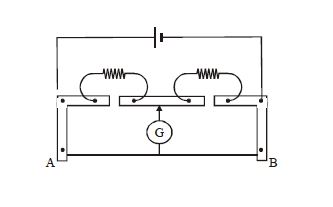
- 3A meter bridge set up as shown to determine end correction at $A$ and $B$. When a resistance of $15\ \Omega$ is used in left gap and of $20\ \Omega$ in right gap, then null point comes at a distance $42\ cm$ from $A$. When these resistances are interchanged null point comes at a distance $57\ cm$ from $A$. Values of end corrections areView Solution
- 4When a current $I$ is passed through a wire of constant resistance, it produces a potential difference $V$ across its ends. The graph drawn between $\log\, I$ and $\log\, V$ will beView Solution
- 5View SolutionThe resistivity of a wire
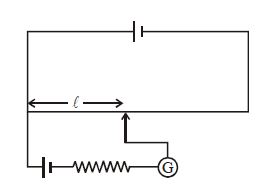
- 6In a potentiometer (see figure) a balance is obtained at a length of $400\ mm$ when using a known battery of emf $1.6\ V$. After removing this battery, another battery of unknown emf is used and balance is obtained at a length of $650\ mm.$ The emf of unknown battery is ............. $volt$View Solution
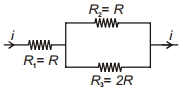
- 7In the circuit shown, the thermal power dissipated in $R_1$ is $P$. The thermal power dissipated in $R_2$ isView Solution
- 8View SolutionIdentify the set in which all the three materials are good conductors of electricity
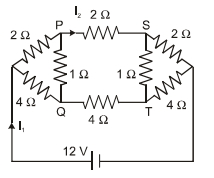
- 9For the resistance network shown in the figure, choose the correct option$(s)$. $Image$View Solution
$(A)$ The current through $P Q$ is zero.
$(B)$ $I_1=3 A$.
$(C)$ The potential at $S$ is less than that at $Q$.
$(D)$ $I _2=2 A$.
- 10An expression for rate of heat generated, if a current of $I$ ampere flows through a resistance of $R$ $\Omega$, isView Solution