The drift velocity of free electrons in a conductor is ‘$v$’ when a current ‘$i$’ is flowing in it. If both the radius and current are doubled, then drift velocity will be
Easy
Download our app for free and get started
(b) ${v_d} = \frac{i}{{ne\pi {r^2}}} \Rightarrow {v_d} \propto \frac{i}{{{r^2}}} \Rightarrow \frac{v}{{v'}} = \frac{{{i_1}}}{{{i_2}}} \times {\left( {\frac{{{r_2}}}{{{r_1}}}} \right)^2}$$ \Rightarrow \,\,v' = \frac{v}{2}$.

Download our appand get started for free
Experience the future of education. Simply download our apps or reach out to us for more information. Let's shape the future of learning together!No signup needed.*
Similar Questions
- 1View SolutionElectroplating does not help in
- 2In a meter bridge experiment null point is obtained at $20\, cm$ from one end of the wire when resistance $X$ is balanced against another resistance $Y$. If $X < Y$, then where will be the new position of the null point from the same end, if one decides to balance a resistance of $4X$ against $Y$ ........... $cm$View Solution
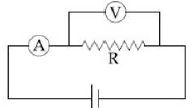
- 3The actual value of resistance $R$, shown in the figure is $30\,\Omega $. This is measured in an experiment as shown using the standard formula $R = \frac{V}{I}$ where $V$ and $I$ are the readings of the voltmeter and ammeter, respectively. If the measured value of $R$ is $5\%$ less, then the internal resistance of the voltmeter is ................. $\Omega$View Solution
- 4A $60\, watt$ bulb operates on $220\,V$ supply. The current flowing through the bulb isView Solution
- 5View SolutionA thick wire is stretched so that its length become two times. Assuming that there is no change in its density, then what is the ratio of change in resistance of wire to the initial resistance of wire
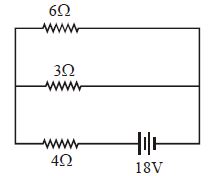
- 6The total power dissipated in watts in the circuit shown is ............. $W$View Solution
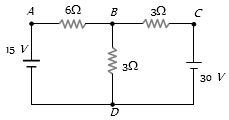
- 7In the circuit shown in figure, find the current through the branch $BD$ ............. $A$View Solution
- 8A cell having an emf $\varepsilon$ and internal resistance $r$ is connected across a variable external resistance $R.$ As the resistance $R$ is increased, the plot of potential difference $V$ across $R$ is given byView Solution
- 9A wire when connected to $220\,V$ mains supply has power dissipation ${P_1}$. Now the wire is cut into two equal pieces which are connected in parallel to the same supply. Power dissipation in this case is ${P_2}$. Then ${P_2}:{P_1}$ isView Solution
- 10$A$ brass disc and a carbon disc of same radius are assembled alternatively to make a cylindrical conductor. The resistance of the cylinder is independent of the temperature. The ratio of thickness of the brass disc to that of the carbon disc is [$\alpha$ is temperature coefficient of resistance and Neglect linear expansion ]View Solution