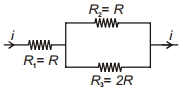
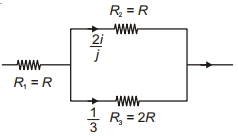
In the circuit shown, the thermal power dissipated in $R_1$ is $P$. The thermal power dissipated in $R_2$ is
Medium


Download our appand get started for free
Experience the future of education. Simply download our apps or reach out to us for more information. Let's shape the future of learning together!No signup needed.*
Similar Questions
- 1$A$ constant voltage is applied between the two ends of a uniform metallic wire. Some heat is developed in it. The heat developed is doubled ifView Solution
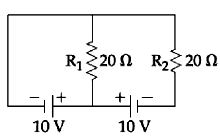
- 2In the given circuit the cells have zero internal resistance. The currents (in Amperes) passing through resistance $R_1$ and $R_2$ respectively, areView Solution
- 3A uniform wire of length $l$ and radius $r$ has a resistance of $100\, \Omega $. It is recast into a wire of radius $\frac{r}{2}$. The resistance of new wire will be ............... $\Omega$View Solution
- 4A uniform wire of resistance $9\, ohm$ is bent in the form of a circle. The effective resistance across the points $A$ and $B$ is ............... $\Omega$View Solution

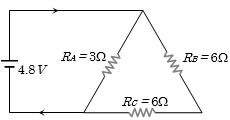
- 5The current in the given circuit is ............ $A$View Solution
- 6View SolutionWhat is immaterial for an electric fuse wire
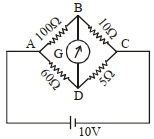
- 7The four arms of a Wheatstone bridge have resistances as shown in the figure. A galvanometer of $15\, \Omega$ resistance is connected across $BD$. Calculate the current through the galvanometer when a potential difference of $10\, V$ is maintained across $AC.$View Solution
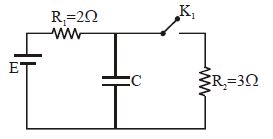
- 8In the circuit shown in the figure $K_1$ is open. The charge on capacitor $C$ in steady state is $q_1$. Now key is closed and at steady state charge on $C$ is $q_2$. The ratio of charges $q_1/q_2$ isView Solution
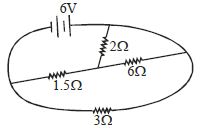
- 9Find the value of current from battery in the circuit ............... $A$View Solution
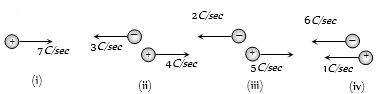
- 10View SolutionFollowing figure shows four situations in which positive and negative charges moves horizontally through a region and gives the rate at which each charge moves. Rank the situations according to the effective current through the region greatest first