MCQ
An engine runs between a reservoir at temperature $200 \,K$ and a hot body which is initially at temperature of $600 \,K$. If the hot body cools down to a temperature of $400 \,K$ in the process, then the maximum amount of work that the engine can do (while working in a cycle) is (the heat capacity of the hot body is $1 \,J / K )$
  • A
    $200(1-\ln 2) \,J$
  • $200(1-\ln 3 / 2) \,J$
  • C
    $200(1+\ln 3 / 2) \,J$
  • D
    $200 \,J$

Answer

Correct option: B.
$200(1-\ln 3 / 2) \,J$
b
$(b)$ The efficiency of engine, $\eta=\frac{W}{Q_{\text {in }}}$ or $W=\eta Q_{\text {in }}$

Also, $Q=\int C d t$

For maximum work, efficiency should be maximum, i.e. for Carnot engine,

$\eta =1-\frac{T_{2}}{T_{1}}=1-\frac{200}{T}$

$\therefore \quad W =\int \eta Q_{\text {in }}$

$=-\int \limits_{600}^{400}\left(1-\frac{200}{T}\right) C d T$

$\Rightarrow \quad W =-C[T-200 \ln T]_{600}^{400}$

$=-C\left[-200+\ln \left(\frac{3}{2}\right) 200\right] J$

Here, $C=1$ (given)

$\therefore \quad W=200-200 \ln \left(\frac{3}{2}\right) \,J$

or $\quad W=200\left[1-\ln \left(\frac{3}{2}\right)\right] \,J$

Need a full question paper?

Generate a complete, print-ready paper with questions like this in minutes — across 16+ boards, with answer keys.

Start Generating Free

Similar questions

A small bob tied at one end of a thin string of length $1\, m$ is describing a vertical circle so that the maximum and minimum tension in the string are in the ratio $5: 1 .$ The velocity of the bob at the height position is ............. $m / s$ (Take $\left.g=10 \,m / s ^{2}\right)$
A glass flask of volume $200 \,cm ^3$ is just filled with mercury at $20^{\circ} C$. The amount of mercury that will overflow when the temperature of the system is raised to $100^{\circ} C$ is ........ $cm ^3$ $\left(\gamma_{\text {glase }}=1.2 \times 10^{-5} / C ^{\circ}, \gamma_{\text {mercury }}=1.8 \times 10^{-4} / C^{\circ}\right)$
Two vessels of different materials are similar in size in every respect. The same quantity of ice filled in them gets melted in $20$ minutes and $40$ minutes respectively. The ratio of thermal conductivities of the materials is 
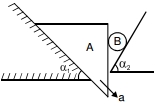
Find the acceleration of $B$.
The displacement equations of two interfering waves are given by

$y_1  =10 \sin \left(\omega t+\frac{\pi}{3}\right) cm$

$y_2 =5[\sin (\omega t)+\sqrt{3} \cos \omega t] \;cm$ respectively.

The amplitude of the resultant wave is $.............cm$.

The density of water at $4^\circ C$ is:
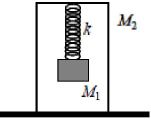
A block of mass $M_1$ is hanged by a light spring of force constant $k$ to the top bar of a reverse $U$ -frame of mass $M_2$ on the floor. The block is pulled down from its equilibrium position by a distance $x$ and then released. The minimum value of $x$ such that the reverse $U$ -frame will leave the floor momentarily, is :-
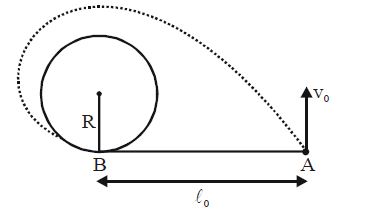
A horizontal plane supports a stationary vertical cylinder of radius $R = 1\ m$ and a disc $A$ attached to the cylinder by a horizontal thread $AB$ of length $l_0 = 2\ m$ (seen in figure, top view). An intial velocity ($v_0 = 1\ m/s$) is imparted $AB$ to the disc as shown in figure. .......... $\sec$ long will it move along the plane until it strikes against the cylinder ? (All surface are assumed to be smooth)
A monoatomic gas at pressure $P$ and volume $V$ is suddenly compressed to one eighth of its original volume. The final pressure at constant entropy will be $.....P$
Four rods of indentical cross-sectional area and made from the same metal form the sides of a square. The temperature of two diagonally opposite points are $\theta$ and $\sqrt2 \theta$ respectively in the  teady state. Assuming that only heat conduction takes place, what will be the temperature difference between other two points ?