MCQ
An ether is more volatile than an alcohol having the same molecular formula. This is due to
  • A
    Dipolar character of ethers
  • B
    Alcohols having resonance structures
  • C
    Inter-molecular hydrogen bonding in ethers
  • Inter-molecular hydrogen bonding in alcohols
Answer

Correct option: D.
Inter-molecular hydrogen bonding in alcohols

d
(d) Due to inter-molecular hydrogen bonding in alcohols boiling point of alcohols is much higher than ether.

Need a full question paper?

Generate a complete, print-ready paper with questions like this in minutes — across 16+ boards, with answer keys.

Start Generating Free

Similar questions

The fragrance of flowers is due to the presence of some steam volatile organic compounds called essential oils. These are generally insoluble in water at room temperature but are miscible with water vapour in vapour phase. $A$ suitable method for the extraction of these oils from the flowers is 
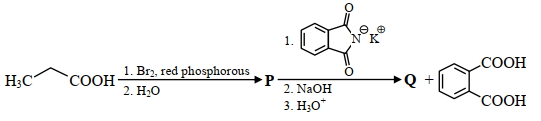
Considering the reaction sequence given below, the correct statement($s$) is(are)

$(A)$ $P$ can be reduced to a primary alcohol using $NaBH _4$.

$(B)$ Treating $P$ with conc. $NH _4 OH$ solution followed by acidification gives $Q$.

$(C)$ Treating $Q$ with a solution of $NaNO _2$ in aq. $HCl$ liberates $N _2$.

$(D)$ $P$ is more acidic than $CH _3 CH _2 COOH$.

One molal solution of a carboxylic acid in benzene shows the elevation of boiling point of $1.518\, K$ . The degree of association for dimerization of the acid in benzene is ........ $\%$. ( $K_b$ for benzene $= 2.53\, K\, kg\, mol^{-1}$ )
Choose correct order of $\Delta {H_{eg}}$ ?

($\Delta {H_{eg}} = e^-$ gain enthalpy)

The following bimolecular elimination reaction $(E_2)$ is carried out with different  halogen leaving groups. The per cent yield of the two products ($2$ -hexene and $1$-hexene) for each leaving group is listed below.

Leaving group Conj. Acid $pK_a$ $\%$ -yield of $2$-hexene $\%$ -yield of $1$ -hexene
$X = I$ $- 10$ $81\%$ $19\%$
$X = Br$ $-9$ $72\%$ $28\%$
$X = Cl$ $-7$ $67\%$ $33\%$
$X = F$ $3.2$ $30\%$ $70\%$

Which of the following statement is (are) true concerning this series of $E_2$ reactions ?

Which of the following is strongest acid ?
$\begin{matrix}
   ONa\,\,\,\,\,\,\,\,\,\,\,\,\,\,\,\,\,\,\,\,\,\,\,\,\,\,\,\,\,\,\,\,\,\,\,\,\,\,\,\,\,\,\,\,\,\,\,\,\,\,\,\,\,\,\,\,\,\,\,  \\
   |\,\,\,\,\,\,\,\,\,\,\,\,\,\,\,\,\,\,\,\,\,\,\,\,\,\,\,\,\,\,\,\,\,\,\,\,\,\,\,\,\,\,\,\,\,\,\,\,\,\,\,\,\,\,\,\,\,\,\,\,\,\,\,\,\,\,\,\,\,\,  \\
   C{{H}_{3}}-C=C{{H}_{2}}\xrightarrow{HC\equiv CH}\xrightarrow{{{H}^{+}}}\xrightarrow[Pd-BaS{{O}_{4}}]{{{H}_{2}}}\xrightarrow[\Delta ]{A{{l}_{2}}{{O}_{3}}}  \\
\end{matrix}$

End product of the reaction is

$PbI_4$ does not exist because
Which one of the following is more acidic
What is the reagent used for testing fluoride ion in water