Question
An ideal gas at pressure $2.5 \times 10^5Pa$ and temperature $300K$ occupies $100cc$. It is adiabatically compressed to half its original volume. Calculate,
  1. The final pressure.
  2. The final temperature.
  3. The work done by the gas in the process. Take $\gamma=1.5.$
Answer

$P_1 = 2.5 \times 10^5Pa, V_1 = 100cc, T_1 = 300k$
  1. $\text{P}_1\text{V}_1^\gamma=\text{P}_2\text{V}_2^\gamma$
$\Rightarrow2.5\times10^5\times\text{V}^{1.5}=\Big(\frac{\text{V}}{2}\Big)^{1.5}\times\text{P}_2$
$\Rightarrow\text{P}_2=2^{1.5}\times2.5\times10^5$
$\Rightarrow\text{P}_2=7.07\times10^5\approx7.1\times10^5$
  1. $\text{T}_1\text{V}_1^{\gamma-1}=\text{T}_2\text{V}_2^{\gamma-1}$
$\Rightarrow300\times(100)^{1.5-1}=\text{T}_2\times(50)^{1.5-1}$
$\Rightarrow\text{T}_2=\frac{3000}{7.07}=424.32\text{k}\approx424\text{k}$
  1. Work done by the gas in the process,
$\text{W}=\frac{\text{mR}}{\gamma-1}[\text{T}_2-\text{T}_1]=\frac{\text{P}_1\text{V}_1}{\text{T}(\gamma-1)}[\text{T}_2-\text{T}_1]$
$\Rightarrow\frac{2.5\times10^5\times100\times10^{-6}}{300(1.5-1)}[424-300]$
$=\frac{2.5\times10}{300\times0.5}\times124=20.72\approx21\text{J}$

Need a full question paper?

Generate a complete, print-ready paper with questions like this in minutes — across 16+ boards, with answer keys.

Start Generating Free

Similar questions

A uniform wheel of radius R is set into rotation about its axis at an angular speed $\omega.$ This rotating wheel is now placed on a rough horizontal surface with its axis horizontal. Because of friction at the contact, the wheel accelerates forward and its rotation decelerates till the wheel starts pure rolling on the surface. Find the linear speed of the wheel after it starts pure rolling.
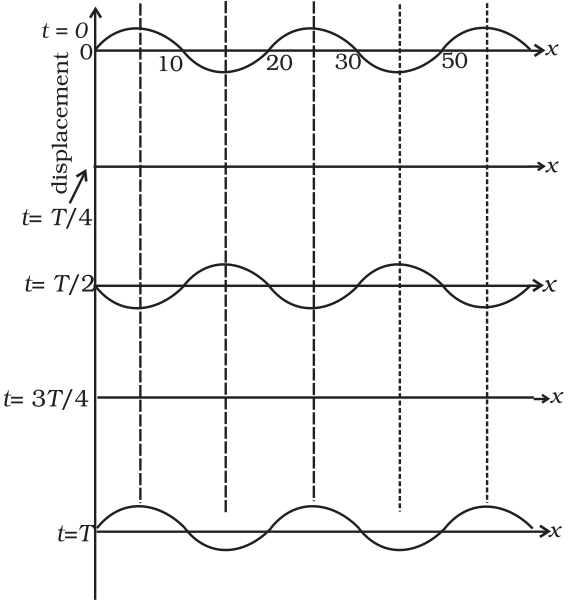
The wave pattern on a stretched string is shown in Interpret what kind of wave this is and find its wavelength.
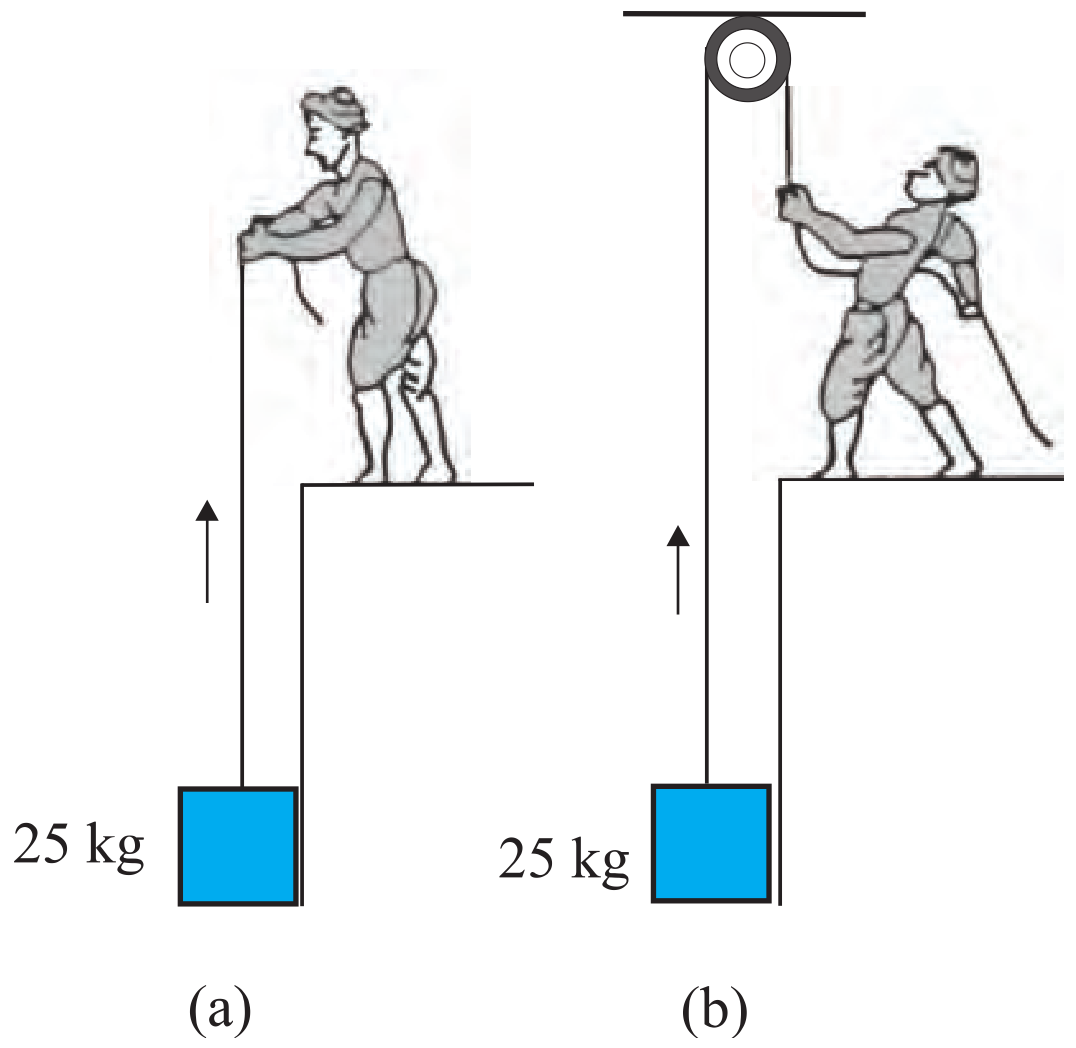
A block of mass $25kg$ is raised by a $50kg$ man in two different ways as shown in Fig. What is the action on the floor by the man in the two cases? If the floor yields to a normal force of $700N$, which mode should the man adopt to lift the block without the floor yielding?
The plates of a capacitor are 2.00cm apart. An electronproton pair is released somewhere in the gap between the plates and it is found that the proton reaches the negative plate at the same time as the electron reaches the positive plate. At what distance from the negative plate was the pair released?
Two particles A and B, having opposite charges $2.0 \times 10^{-6}C$ and $2.0 \times 10^{-6}C$, are placed at a separation of 1.0cm.
  1. Write down the electric dipole moment of this pair.
  2. Calculate the electric field at a point on the axis of the dipole 1.0m awa.y from the centre.
  3. Calculate the electric field at a point on the perpendicular bisector of the dipole and 1.0m away from the centre.
If $28 \times 10^{23}$ molecules of a gas strike a surface of area $14 \mathrm{~cm}^2$ normally per second with velocity of $500 \mathrm{~ms}^{-1}$ and rebound in the opposite direction with the same speed find the pressure exerted by the gas on the surface if mass of each molecule is $5 \times 10^{-23} \mathrm{~g}$.
Find the expression for kinetic energy, potential energy and total energy of a particle executing SHM.
The position of a particle is given by $\text{r}=3.0\text{t}\hat{\text{i}}-2.0\text{t}^2\hat{\text{j}}+4.0\hat{\text{k }}\text{m}$ Where t is in seconds and the coefficients have the proper units for r to be in metres. (a) Find the v and a of the particle? (b) What is the magnitude and direction of velocity of the particle at t = 2.0s?
The length of a second’s pendulum on the surface of Earth is 1m. What will be the length of a second’s pendulum on the moon?
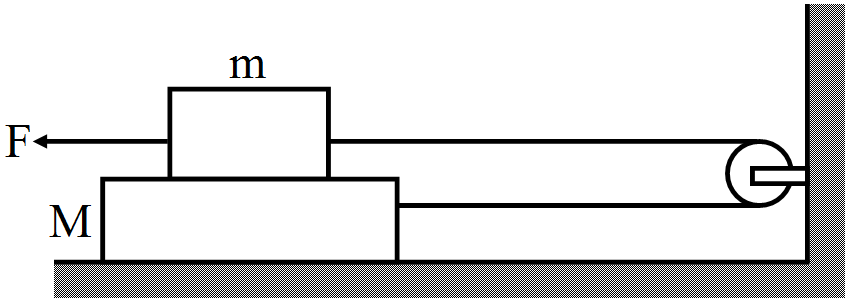
The friction coefficient between the two blocks shown in figure is $\mu$ but the floor is smooth.
  1. What maximum horizontal force F can be applied without disturbing the equilibrium of the system?
  2. Suppose the horizontal force applied is double of that found in part (a). Find the accelerations of the two masses.