Question
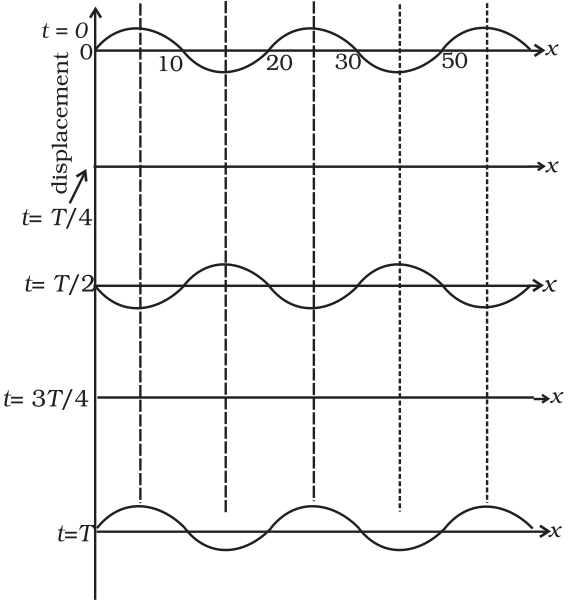
The wave pattern on a stretched string is shown in Interpret what kind of wave this is and find its wavelength.

Answer

The displacement of medium particlles at distance 10, 20, 30, 40, and 50cm are always rest which is the property of nodes in stationary wave.$\text{AT}\ \text{t}=\frac{\text{T}}{4}$ and $\frac{\text{3T}}{4}$ all particle are at rest wgich is in stationary wave when the particle crossrs its mean position.
so thet praph of wave shos stationaty wave. The wave at $\text{x}=10,\ 20,\ 30,\ 40\text{cm}$ there are nodes and distance between successive nodes is $\frac{\lambda}{2}$$\therefore\frac{\lambda}{2}=(30-20)$ or $\lambda=20\text{cm.}$

Need a full question paper?

Generate a complete, print-ready paper with questions like this in minutes — across 16+ boards, with answer keys.
Start Generating Free

Similar questions

Four identical cylindrical columns of steel support a big structure of mass $50,000kg$. The inner and outer radii of each column are $30cm$ and $40cm$ respectively. Assume the load distribution to be uniform, calculate the compressional strain of each column. The Young's modulus of steel is $2.0 \times 10^{11}Pa$.
A child running a temperature of $101°F$ is given an antipyrin (i.e. a medicine that lowers fever) which causes an increase in the rate of evaporation of sweat from his body. If the fever is brought down to $98°F$ in $20$ minutes, what is the average rate of extra evaporation caused, by the drug. Assume the evaporation mechanism to be the only way by which heat is lost. The mass of the child is $30kg$. The specific heat of human body is approximately the same as that of water, and latent heat of evaporation of water at that temperature is about $580cal\ g^{–1}$.
Prove the following:
  1. For two angles of projection $\theta$ and $(90-\theta)$ with same velocity v,
  1. Range is same.
  2. Heights are in the ratio $\tan^2: 1$.
  1. If the range and maximum height are equal, the angle of projection is $\tan^{-1}(4)$.
What are beats? Prove that the number of beats produced per second by the two sound sources is equal to the difference between their frequencies.
Find the wavelength of the radiation emitted by hydrogen in the transitions
(a) $n = 3$ to $n= 2$,
(b) $n = 5$ to $n = 4$ and
(c) $n = 10$ to $n = 9$.
A narrow sound pulse (for example, a short pip by a whistle) is sent across a medium.
(a) Does the pulse have a definite,
  1. frequency,
  2. wavelength,
  3. speed of propagation?
(b) If the pulse rate is 1 after every 20s, (that is the whistle is blown for a split of second after every 20s), is the frequency of the note produced by the whistle equal to 1/20 or 0.05Hz?
You are riding in an automatic vehicle of mass 3000 kg . Assume that you are testing the oscillatory characteristics of the suspension system of this vechicle when the entire vehicle is placed on it, the suspended is inclined by 15 cm . Also, the amplitude of oscillation decreases by $50 \%$ in the period of one complete oscillation. Estimate the value of the following
(a) spring constant, and
(b) for the shock absorber system of a spring and $a$ wheel damping constant $b$.
Assume that each wheel carries a mass of 750 kg is.
Ten small planes are flying at a speed of 150km/h in total darkness in an air space that is 20 × 20 × 1.5km 3 in volume. You are in one of the planes, flying at random within this space with no way of knowing where the other planes are. On the average about how long a time will elapse between near collision with your plane. Assume for this rough computation that a safety region around the plane can be approximated by a sphere of radius 10m.
A smooth sphere of radius R is made to translate in a straight line with a constant acceleration a. A particle kept on the top of the sphere is released from there at zero velocity with respect to the sphere. Find the speed of the particle with respect to the sphere as a function of the angle $\theta$ it slides.
A block is kept on a horizontal table. The table is undergoing S.H.M. of frequency 3Hz in a horizontal plane. The coefficient of static friction between block and the table surface is 0.72. Find the maximum amplitude of the table at which the block does not slip on the surface.