MCQ
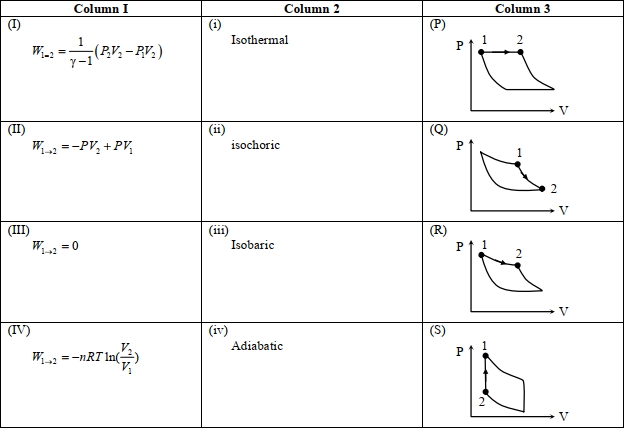
An ideal gas is undergoing a cyclic thermodynamic process in different ways as shown in the corresponding $P$ $V$ diagrams in column $3$ of the table. Consider only the path from state $1$ to $2 . W$ denotes the corresponding work done on the system. The equations and plots in the table have standard notations as used in thermodynamic processes. Here $\gamma$ is the ratio of heat capacities at constant pressure and constant volume. The number of moles in the gas is $n$.

(image)

($1$) Which of the following options is the only correct representation of a process in which $\Delta U=\Delta Q-P \Delta V$ ?

$[A] (II) (iv) (R)$    $[B] (II) (iii) (P)$    $[C] (II) (iii) (S)$   $[D] (III) (iii) (P)$

($2$)  Which one of the following options is the correct combination?

$[A] (III) (ii) (S)$    $[B] (II) (iv) (R)$   $[C] (II) (iv) (P)$   $[D] (IV) (ii) (S)$

($3$) Which one of the following options correctly represents a thermodynamic process that is used as a correction in the determination of the speed of sound in an ideal gas?

$[A] (III) (iv) (R)$  $[B] (I) (ii)$ $(\mathrm{Q})$   $[C] (IV) (ii) (R)$    $[D] (I) (iv) (Q)$
  • A
    $B,A,C$
  • $B,A,D$
  • C
    $B,A$
  • D
    $B,D$

Answer

Correct option: B.
$B,A,D$
b
($1$) The process must be isobaric.

($2$) The correct combination is for isochoric process.

($3$) The process must be adiabatic, which is used in Laplace correction over Newton's law for sound speed in air.

Need a full question paper?

Generate a complete, print-ready paper with questions like this in minutes — across 16+ boards, with answer keys.

Start Generating Free

Similar questions

Which one of the following statements is true
A spherical ball of radius $1 \times 10^{-4} \mathrm{~m}$ and density $10^5$ $\mathrm{kg} / \mathrm{m}^3$ falls freely under gravity through a distance $h$ before entering a tank of water, If after entering in water the velocity of the ball does not change, then the value of $h$ is approximately:

(The coefficient of viscosity of water is $9.8 \times 10^{-6}$ $\left.\mathrm{N} \mathrm{s} / \mathrm{m}^2\right)$

A ball is thrown upwards at an angle of $60^o$ to the horizontal. It falls on the ground at a distance of $90 \,m$. If the ball is thrown with the same initial velocity at an angle $30^o$, it will fall on the ground at a distance of ........ $m$
One end of massless rope, which passes over a massless and frictionless pulley $P$ is tied to a hook while the other is free. Maximum tension the rope bear is $360 N$. With what value of maximum safe acceleration (in $m s^{-2}$) can a man of $60 kg$ climb on the rope?
A couple produces
$\hat i.\left( {\hat j \times \,\,\hat k} \right) + \;\,\hat j\,.\,\left( {\hat k \times \hat i} \right) + \hat k.\left( {\hat i \times \hat j} \right)=$
A car is travelling with linear velocity $v$ on a circular road of radius $r$. If it is increasing its speed at the rate of $'a'$ $meter/{\sec ^2}$, then the resultant acceleration will be
Stress-strain curves for the material $A$ and $B$ are shown below: Then,
The state of an ideal gas was changed isobarically. The graph depicts three such isobaric lines. Which of the following is true about the pressures of the gas?
Two projectiles, one fired from surface of earth with velocity $10 \,m/s$ and other fired  from the surface of another planet with initial speed $5\, m/s$ trace identical trajectories.  The value of acceleration due to the gravity on the planet is   ......... $m/s^2$