MCQ
When an object covers equal distances in equal time intervals, then its speed is:
  • A
    slow motion
  • B
    accelerated pace
  • C
    uneven motion
  • uneven motion

Answer

Correct option: D.
uneven motion
d

Need a full question paper?

Generate a complete, print-ready paper with questions like this in minutes — across 16+ boards, with answer keys.
Start Generating Free

Similar questions

When a particle moves in a uniform circular motion. It has
The earth is assumed to be a sphere of radius $R.$ A platform is arranged at a height $R$ from the surface of the earth. The escape velocity of a body from this platform is $fv$, where $v$ is its escape velocity from the surface of the Earth. The value of $f$ is
An $\text{AND}$ gate can be prepared by repetitive use of:
  1. $\text{NOT}$ gate.
  2. $\text{OR}$ gate.
  3. $\text{NAND}$ gate.
  4. $\text{NOR}$ gate.
A particle falls from a height $h $ upon a fixed horizontal plane and rebounds. If $e$ is the coefficient of restitution, the total distance travelled before rebounding has stopped is
Which of the following quantities can be written in $\text{SI}$ units in $\ce{kg^2 m^2 A^{-2}S^{-3}}?$
A gas at ${27}^\circ C$ temperature and $30$ atmospheric pressure is allowed to expand to the atmospheric pressure. If the volume becomes $10$ times its initial volume, then the final temperature becomes ...... $^oC$
Asphere of radius $R$ and made of material of relative density $\sigma$ has a concentric cavity of radius $r$. It just floats when placed in a tank full of water. The value of the ratio $R/r$ will be 
A person standing on a spring balance inside a stationary lift measures $60 \,kg$. The weight of that person if the lift descends with uniform downward acceleration of $1.8\, m / s ^{2}$ will be $_{-} N$. $\left[ g =10\, m / s ^{2}\right]$
A cubical block is floating in a liquid with one fourth of its volume immersed in the liquid. If whole of the system accelerates upward with acceleration $g / 4$, the fraction of volume immersed in the liquid will be ..........
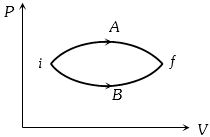
In the figure given two processes $A$ and $B$ are shown by which a thermo-dynamical system goes from initial to final state $F.$ If $\Delta {Q_A}$ and $\Delta {Q_B}$ are respectively the heats supplied to the systems then