Question
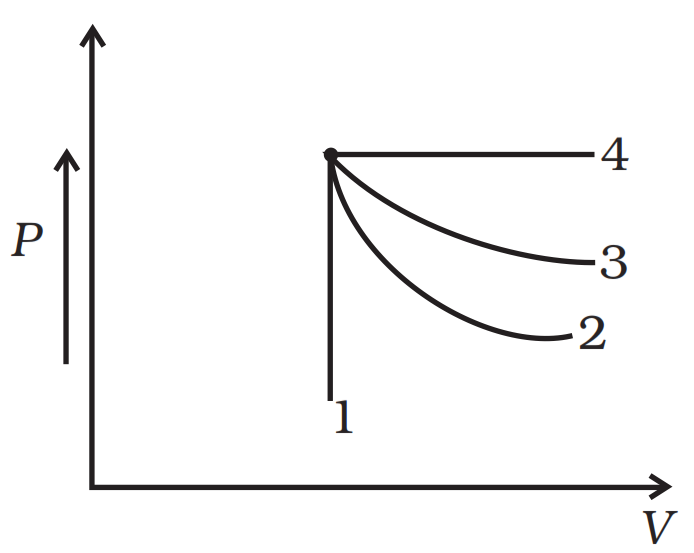
An ideal gas undergoes four different processes from thesame initial state (Fig.). Four processes are adiabatic, isothermal, isobaric and isochoric. Out of 1, 2, 3 and 4 whichone is adiabatic.
- 4
- 3
- 2
- 1
Explanation:
4 is isobaric process, 1 is isochoric. out of 3 and 2, 3 has the smaller slope (magnitude) hence is isothermal. Remaining process 2 is adiabatic.
Generate a complete, print-ready paper with questions like this in minutes — across 16+ boards, with answer keys.
${x_1} = a\sin (\omega \,t + {\phi _1})$, ${x_2} = a\sin \,(\omega \,t + {\phi _2})$
If in the resultant wave the frequency and amplitude remain equal to those of superimposing waves. Then phase difference between them is
$STATEMENT-2$ The magnitude of frictional force depends on the nature of the two surfaces in contact.
$\text{B}_\text{y},=\text{B}_\text{y}+\frac{\text{vE}_\text{z}}{\text{c}^2}$
$\text{E}_\text{y},=\text{E}_\text{y}+\frac{\text{vB}_\text{z}}{\text{c}^2}$
$\text{B}'_\text{y}=\text{B}_\text{y}+\text{v}\text{E}_\text{z}$
$\text{E}'_\text{y}=\text{E}_\text{y}+\text{vB}_\text{z}$