Questions

M.C.Q (1 Marks)

Take a timed test

11 questions · self-marked practice — reveal the answer and mark yourself.

Question 11 Mark
If an average person jogs, he produces 14.5 × 10³ cal/ min. This is removed by the evaporation of sweat. The amount of sweat evaporated per minute (assuming 1kg requires 580 × 103cal for evaparation) is
  1. 0.25kg
  2. 2.25kg
  3. 0.05kg
  4. 0.20kg
Answer
  1. 0.25kg

Explanation:

580 × 10Calories are needed to convert 1kg H2O into steam.

1cal will producer sweat $=\frac{1}{580\times10^{3}}$

14.5 × 103cal will producer sweat $=\frac{14.5\times10^3}{580\times10^3}$

$=\frac{145}{5800}\text{kg }\text{per}\text{minute}=0.25\text{kg }\text{per}\text{minute}$
View full question & answer
Question 21 Mark
Which of the processes described below are irreversible?
  1. The increase in temprature of an iron rod by hammering it.
  2. A gas in a small cantainer at a temprature T1 is brought in contact with a big reservoir at a higher temprature T2 which increases the temprature of the gas.
  3. A quasi-static isothermal expansion of an ideal gas in cylinder fitted with a frictionless piston.
  4. An ideal gas is enclosed in a piston cylinder arrangement with adiabatic walls. A weight W is added to the piston, resulting in compression of gas.
Answer
  1. The increase in temprature of an iron rod by hammering it.
  2. A gas in a small cantainer at a temprature T1 is brought in contact with a big reservoir at a higher temprature T2 which increases the temprature of the gas.
  3. A quasi-static isothermal expansion of an ideal gas in cylinder fitted with a frictionless piston

Explanation:

Key concept: Reversible process: A reversible process is one which can be reversed in such a way that all changes occurring in the direct process are exactly repeated in the opposite order and inverse sense and no change is left in any of the bodies taking part in the process or in the surroundings.
The conditions for reversibility are:

  • There must be complete absence of dissipative forces such as friction, viscosity, electric resistance etc. ~
  • The direct and reverse processes must take place infinitely slowly.
  • The temperature of the system must not differ appreciably from its surroundings.

Irreversible process: Any process which is not reversible exactly is an irreversible process. All natural processes such as conduction, radiation, radioactive decay etc. are irreversible. All practical processes such as free expansion, Joule-Thomson expansion, electrical heating of a wire are also irreversible.

  1. In this case internal energy of the rod is increased from external work done by hammer which in turn increases its temperature. So, the process cannot be retraced itself.
  2. In this process energy in the form of heat is transferred to the gas in the small container by big reservoir at temperature T
  3. In a quasi-static isothermal expansion, the gas is ideal, this process is reversible because the cylinder is fitted with frictionless piston.
  4. As the weight is added to the cylinder arrangement in the form of external pressure hence, it cannot be reversed back itself.
View full question & answer
Question 31 Mark
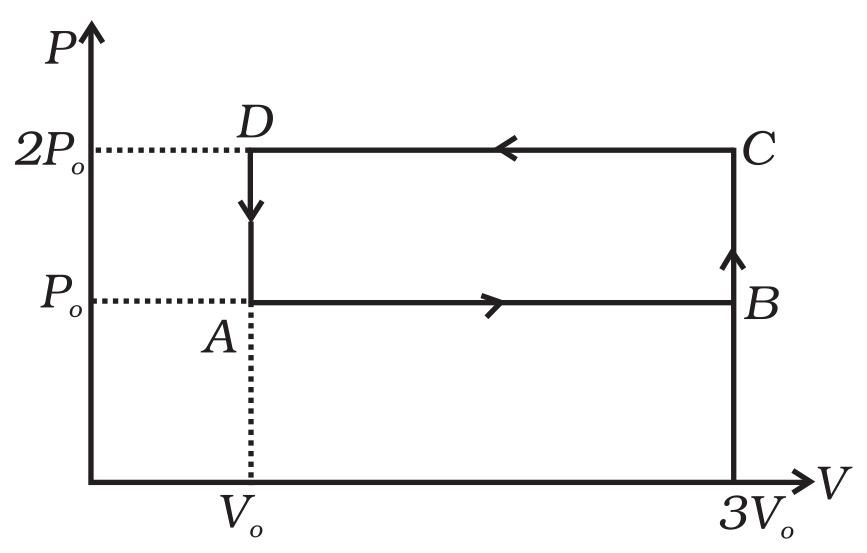
An ideal gas undergoes cyclic process ABCDA as shown in given PV diagram. The amount of work done by the gas is:

  1. $6\text{P}_0\text{V}_0$

  2. $-2\text{P}_0\text{V}_0$

  3. $+2\text{P}_0\text{V}_0$

  4. $+4\text{P}_0\text{V}_0$

Answer
  1. $+4\text{P}_0\text{V}_0$

Explanation:

The direction of arrows is anticlockwise so work done is negative equal to the area of loop $=-(3\text{V}_0-\text{V}_0)(2\text{P}_0-\text{P}_0)=-2\text{P}_0\text{V}_0$ verifies the option (b). New work implies external work is done on the system.

View full question & answer
Question 41 Mark
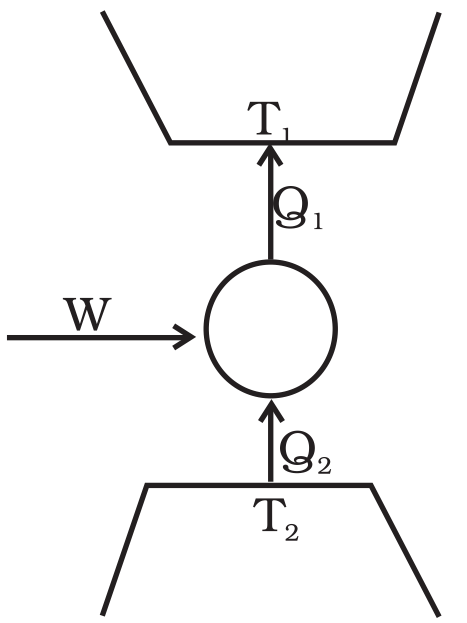
Consider a heat engine as shown in Q1 and Q2 are heat added to heat bath T1 and heat taken from T2 in one cycle of engine. W is the mechanical work done on the engine. If W > 0, then possibilities are:

  1. $\text{Q}_1>\text{Q}_2>0$
  2. $\text{Q}_2>\text{Q}_1>0$
  3. $\text{Q}_2<\text{Q}_1<0$
  4. $\text{Q}_1<0,\text{Q}_2>0$

Answer
  1. ​​​​​​$\text{Q}_1>\text{Q}_2>0$
  1. $\text{Q}_2<\text{Q}_1<0$

Explanation:

From $\text{Q}_{1}=\text{W}+\text{Q}_{2}$ 

$\therefore\text{W}>0$ So $\therefore\text{Q}_{1}-\text{Q}_{2}$ or $\text{Q}_{1}>0$

$\therefore\text{Q}_{1}>\text{Q}_{2}>0$ if both $\text{Q}_{1},\text{Q}_{2}$ position verifies option (a).

Or $\text{Q}_{2}<\text{Q}_{1}<0$ if both $\text{Q}_{1}\text{Q}_{2}$ negative verifies option (c).

View full question & answer
Question 51 Mark
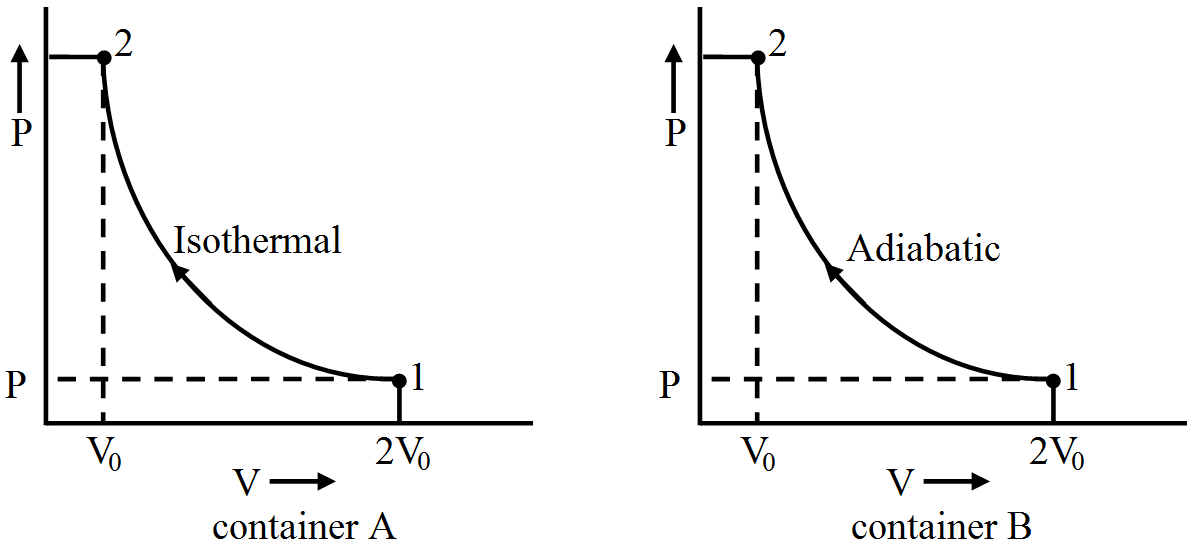
Consider two containers A and B containing identical gases at the same pressure, volume and temperature. The gas in container A is compressed to half of its original volume isothermally while the gas in container B is compressed to half of its original value adiabatically. The ratio of final pressure of gas in B to that of gas in A is

  1. $2^{\gamma-1}$

  2. $\Big(\frac{1}{2}\Big)^{\gamma-1}$

  3. $\Big(\frac{1}{1-\gamma}\Big)^2$

  4. $\Big(\frac{1}{\gamma-1}\Big)^2$

Answer
  1. $2^{\gamma-1}$

Explanation:

According to the P-V diagram shown for the container A (which is going through isothermal process) and for container B (which is going through adiabatic process).

Both the process involves compression of the gas.

(I) Isothermal compression (gas A) (during 1 → 2)

$\text{P}_{1}\text{V}_{1}=\text{P}_{2}\text{V}_{2}$

$\Rightarrow\text{P}_{0}(2\text{V}_{0})^\gamma=\text{P}_{2}(\text{V}_{0})^\gamma$

$\Rightarrow\text{P}_{0}(2\text{V}_{0})=\text{P}_{2}(\text{V}_{0})$

(ii) Adiabatic compression, (gas B) (during 1 → 2)

$\text{P}_{1}\text{V}_{1} ^\gamma=\text{P}_{2}\text{V}_{2}^\gamma$

$\text{P}_{0}(2\text{V}_{0})^\gamma=\text{P}_{2}(\text{V}_{0})^\gamma$

$\text{P}_{2}=\Big(\frac{2\text{V}_{0}}{\text{V}_{0}}\Big)^\gamma\text{P}_{0}=(2)^\gamma\text{P}_{0}$

Hence $\frac{(\text{P}_{2})_\text{B}}{(\text{P}_{2})_\text{A}}=$ Ratio of final pressure $=\frac{(2)^\gamma\text{P}_{0}}{2\text{P}_{0}}=2^{\gamma-1}$

where, $\gamma$ is ratio of specific heat capacities for the gas.

View full question & answer
Question 61 Mark
Three copper blocks of masses M1, M2 and M3kg respectively are brought into thermal contact till they reach equilibrium. Before contact, they were at T1, T2, T3 (T1 > T2 > T3). Assuming there is no heat loss to the surroundings, the equilibrium temprature T is (s is specific heat of copper)

  1. $\text{T}=\frac{\text{T}_{1}+\text{T}_{2}+\text{T}_{3}}{3}$

  2. $\text{T}=\frac{\text{M}_{1}\text{T}_{1}+\text{M}_{2}\text{T}_{2}+\text{M}_{3}\text{T}_{3}}{\text{M}_{1}+\text{M}_{2}+\text{M}_{3}}$

  3. $\text{T}=\frac{\text{M}_{1}\text{T}_{1}+\text{M}_{2}\text{T}_{2}+\text{M}_{3}\text{T}_{3}}{3(\text{M}_{1}+\text{M}_{2}+\text{M}_{3})}$

  4. $\text{T}=\frac{\text{M}_{1}\text{T}_{1}\text{S}+\text{M}_{2}\text{T}_{2}\text{S}+\text{M}_{3}\text{T}_{3}\text{S}}{\text{M}_{1}+\text{M}_{2}+\text{M}_{3}}$

Answer
  1. $\text{T}=\frac{\text{M}_{1}\text{T}_{1}+\text{M}_{2}\text{T}_{2}+\text{M}_{3}\text{T}_{3}}{\text{M}_{1}+\text{M}_{2}+\text{M}_{3}}$

Explanation:

Let the equilibrium tempreature of the system = T

Let $\text{T}_{1}\text{T}_{2}<\text{T}<\text{T}_{3}$

As there is no loss to the surrounding.

Heat lost by $\text{M}_{3}=$ Heat gain by $\text{M}_{1}$+Heat gain by $\text{M}_{2}$

$\text{M}_{3}\text{s}(\text{T}_{3}-\text{T})=\text{M}_{1}\text{s}(\text{T}-\text{T}_{1})+\text{M}_{2}\text{s}(\text{T}-\text{T}_{2})$

$\text{M}_{3}\text{s}\text{T}_{3}-\text{M}_{3}\text{s}\text{T}=\text{M}_{1}\text{s}\text{T}=\text{M}_{1}\text{s}\text{T}-\text{M}_{1}\text{s}\text{T}_{1}+\text{M}_{2}\text{s}\text{T}-\text{M}_{2}\text{s}\text{T}_{2}$

$\text{T}(\text{M}_{3}+\text{M}_{1}+\text{M}_{2})=[\text{M}_{3}\text{T}_{3}+\text{M}_{1}\text{T}_{1}+\text{M}_{2}\text{T}_{2}]$

$\text{T}=\frac{\text{M}_{1}\text{T}_{1}+\text{M}_{2}\text{T}_{2}+\text{M}_{3}\text{T}_{3}}{\text{M}_{1}+\text{M}_{2}+\text{M}_{3}}$

Hence verifies option (b).

View full question & answer
Question 71 Mark
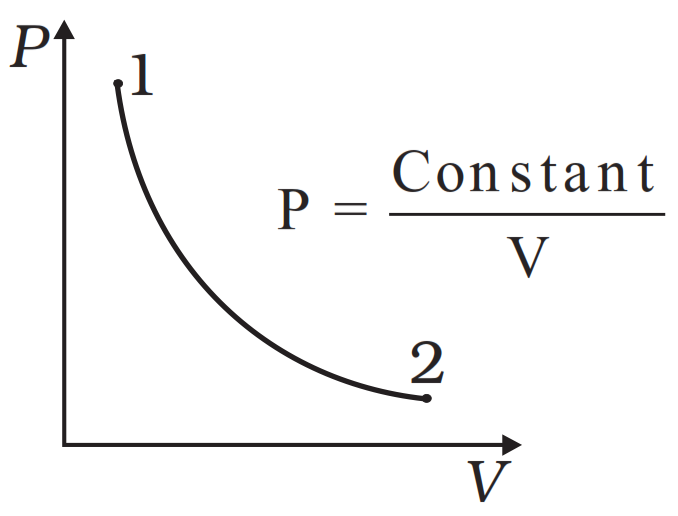
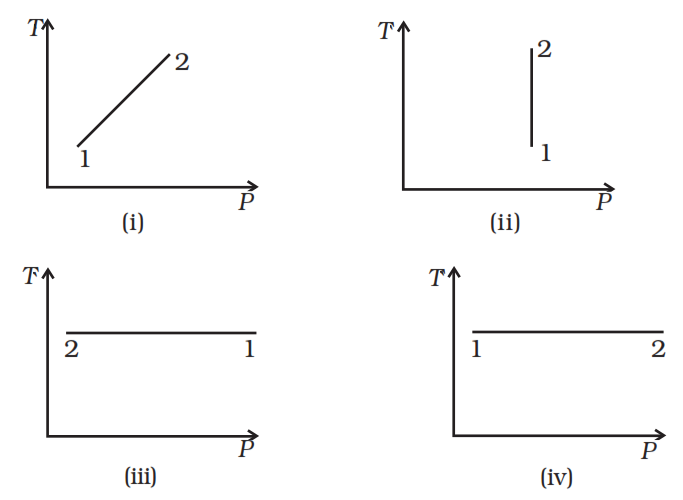
Consider P-V diagram for an ideal gas shown in:

Out of the following diagrams which represents the T-P diagram?
  1. (iv)
  2. (ii)
  3. (iii)
  4. (i)
Answer
  1. (iii)

Explanation:

According to P-V diagram at constant tempreature, P increase as V decrease. So, it is Boyei's law in option (iii) and (iv). If P increase at constant tempreature, volume V decrease. as in (iii) T-P diagram, P is smaller at 2 and larger at 1, which tallies with option c.

View full question & answer
Question 81 Mark
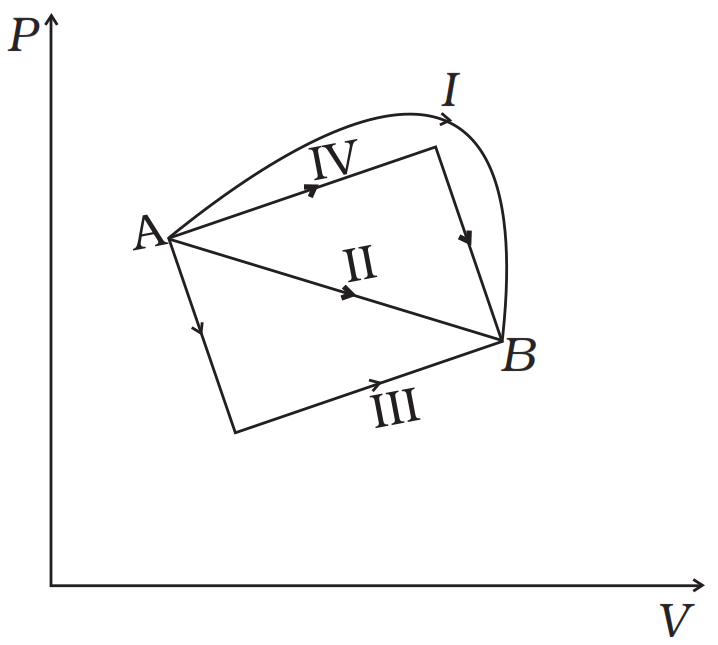
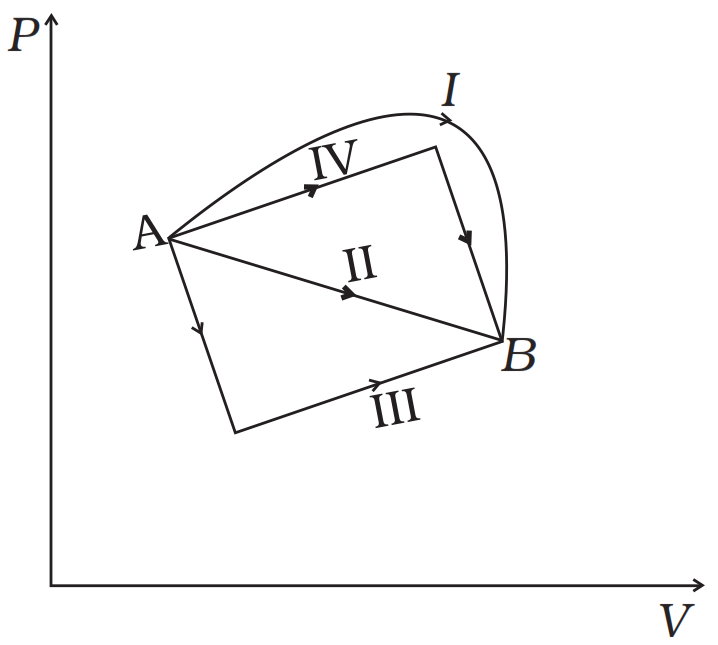
Figure. shows the P-V diagram of an ideal gas undergoing a change of state from A to B. Four different parts I, II, III and IV as shown in the figure may lead to the same change of state.

  1. Change in internal energy is same in IV and III cases, but not in I and II.
  2. Change in internal energy is same in all the four cases.
  3. Work done is maximum in case I
  4. Work done is minimum in case II.

Answer
  1. Change in internal energy is same in all the four case.
  2. Work done is maximum in case I

Explanation:

Main concept used: dU does not depend on P-V path, it depends on initial and final position. WD is P-V is equal to area enclosed with V-axis

The initial and final position are same for different parts I, II, III, IV. So is same. Hence option (a) rejected verifies option (b). As the area enclosed by path I is maximum with V-axis, SO W.D. during path I is maximum and minimum is in III

Hence option (c) verifies and option (d) rejected.

View full question & answer
Question 91 Mark
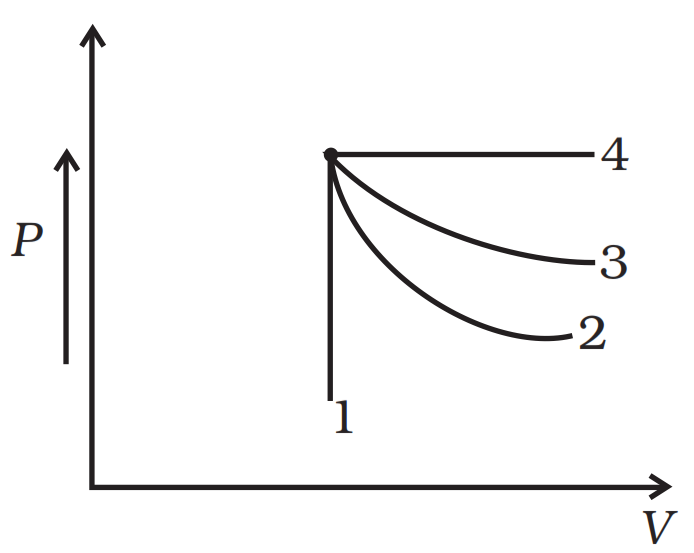
An ideal gas undergoes four different processes from thesame initial state (Fig.). Four processes are adiabatic, isothermal, isobaric and isochoric. Out of 1, 2, 3 and 4 whichone is adiabatic.

  1. 4
  2. 3
  3. 2
  4. 1
Answer
  1. 2

Explanation:

4 is isobaric process, 1 is isochoric. out of 3 and 2, 3 has the smaller slope (magnitude) hence is isothermal. Remaining process 2 is adiabatic.

View full question & answer
Question 101 Mark
An ideal gas undergoes isothermal process from some initial state i to final state f. Choose the correct alternatives.
  1. dU = 0
  2. dQ= 0
  3. dQ = dU
  4. dQ = dW
Answer
  1. dU = 0
  1. dQ = dW

Explanation:

Key concept: First Law of Thermodynamics.

It is a statement of conservation of energy in thermodynamical process.

According to it heat given to a system $(\Delta\text{Q})$ is equal to the sum of increase in its internal energy (AIT) and the work done (AW) by the system against the surroundings.

$\Delta\text{Q}=\Delta\text{U}+\Delta\text{W}$

According to the first law of thermodynamics. $\Delta\text{A}\text{Q}=\Delta\text{U}+\Delta\text{W}$ but

$\Delta\text{U}\propto\Delta\text{T}$

$\Delta\text{U}=0[\text{As } \Delta\text{T}=0]$

$\Delta\text{Q}=\Delta\text{W}$, i.e., heat supplied in an isothermal change is used to do work against external surrounding or if the work is done on the system then equal amount of heat energy will be liberated by the system

View full question & answer
Question 111 Mark
Consider a cycle followed by an engine:

1 to 2 is isothermal.

2 to 3 is adiabatic.

3 to 1 is adiabatic.

Such a process does not exist because:

  1. heat is completely converted to mechanical energy in such a process, which is not possible.
  2. mechanical energy is completely converted to heat in this process, which is not possible.
  3. curves representing two adiabatic processes don’t intersect.
  4. curves representing an adiabatic process and an isothermal process don’t intersect.

​​​​​

Answer
  1. heat is completely converted to mechanical energy in such a process, which is not possible.
  2. curves representing two adiabatic processes don’t intersect.

Explanation:

  1. The given process is a cyclic process, i.e. it returns to the original state 1. And change in internal energy in a cyclic process is always zero as for cyclic process$\text{U}_\text{f}=\text{U}_\text{i}\ \text{So},\Delta\text{U}=\text{U}_\text{f}-\text{U}_\text{i}=0$ Hence, total heat is completely converted to mechanical energy. Such a process is not possible by second law of thermodynamics.
  2. Here, two curves are intersecting, when the gas expands adiabatically from 2 to 3. It is not possible to return to the same state without being heat supplied, hence the process 3 to 1 cannot be adiabatic. So, we conclude that such a process does not exist because curves representing two adiabatic processes do not intersect.
View full question & answer
M.C.Q (1 Marks) - Physics STD 11 Science Questions - Vidyadip