An incandescent bulb has a thin filament of tungsten that is heated to high temperature by passing an electric current. The hot filament emits black-body radiation. The filament is observed to break up at random locations after a sufficiently long time of operation due to non-uniform evaporation of tungsten from the filament. If the bulb is powered at constant voltage, which of the following statement($s$) is(are) true?
($A$) The temperature distribution over the filament is uniform
($B$) The resistance over small sections of the filament decreases with time
($C$) The filament emits more light at higher band of frequencies before it breaks up
($D$) The filament consumes less electrical power towards the end of the life of the bulb
IIT 2016, Diffcult
Download our app for free and get started
Towards the end of the life, filament will become thinner. Resistance will increase and so consumed power will be less, so it will emit less light. Temperature distribution will be non uniform. At the position where temperature is maximum, filament will break. Black body radiation curve will become flat so the filament consumes less electrical power towards the end of the life of the bulb.

Download our appand get started for free
Experience the future of education. Simply download our apps or reach out to us for more information. Let's shape the future of learning together!No signup needed.*
Similar Questions
- 1The filament of a light bulb has surface area $64 mm ^2$. The filament can be considered as a black body at temperature $2500 K$ emitting radiation like a point source when viewed from far. At night the light bulb is observed from a distance of $100 m$. Assume the pupil of the eyes of the observer to be circular with radius $3 mm$. ThenView Solution
(Take Stefan-Boltzmann constant $=5.67 \times 10^{-8} Wm ^{-2} K ^{-4}$, Wien's displacement constant $=2.90 \times 10^{-3} m - K$, Planck's constant $=6.63 \times 10^{-34} Js$, speed of light in vacuum $=3.00 \times 10^8 ms ^{-1}$ )-
$(A)$ power radiated by the filament is in the range $642 W$ to $645 W$
$(B)$ radiated power entering into one eye of the observer is in the range $3.15 \times 10^{-8} W$ to $3.25 \times 10^{-8} W$
$(C)$ the wavelength corresponding to the maximum intensity of light is $1160 nm$
$(D)$ taking the average wavelength of emitted radiation to be $1740 nm$, the total number of photons entering per second into one eye of the observer is in the range $2.75 \times 10^{11}$ to $2.85 \times 10^{11}$
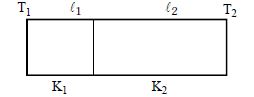
- 2One end of a thermally insulated rod is kept at a temperature $T_1$ and the other at $T_2$. The rod is composed of two sections of lengths $l_1$ and $l_2$ and thermal conductivities $K_1$ and $K_2$ respectively. The temperature at the interface of the two sections isView Solution
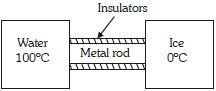
- 3An insulated container is filled with ice at $0\,^oC$ , and another container is filled with water that is continuously boiling at $100\,^oC$ . In series of experiments, the containers are connected by various thick metal rods that pass through the walls of container as shown in the figureView Solution
In the experiment $I$ : a copper rod is used and all ice melts in $20$ minutes.
In the experiment $II$ : a steel rod of identical dimensions is used and all ice melts in $80$ minutes.
In the experiment $III$ : both the rods are used in series and all ice melts in $t_{10}$ minutes.
In the experiment $IV$ : both rods are used in parallel and all ice melts in $t_{20}$ minutes.
- 4The energy emitted per second by a black body at $27^o\ C$ is $10\ J$. If the temperature of the black body is increased to $327^o\ C$ , the energy emitted per second will be ......... $J$View Solution
- 5Two thin metallic spherical shells of radii ${r}_{1}$ and ${r}_{2}$ $\left({r}_{1}<{r}_{2}\right)$ are placed with their centres coinciding. A material of thermal conductivity ${K}$ is filled in the space between the shells. The inner shell is maintained at temperature $\theta_{1}$ and the outer shell at temperature $\theta_{2}\left(\theta_{1}<\theta_{2}\right)$. The rate at which heat flows radially through the material is :-View Solution
- 6A hot body, obeying Newton's law of cooling is cooling down from its peak value $80\,^oC$ to an ambient temperature of $30\,^oC$ . It takes $5\, minutes$ in cooling down from $80\,^oC$ to $40\,^oC$. ........ $\min.$ will it take to cool down from $62\,^oC$ to $32\,^oC$ ? (Given $ln\, 2\, = 0.693, ln\, 5\, = 1.609$)View Solution
- 7The two ends of a rod of length $L$ and a uniform cross-sectional area $A$ are kept at two temperatures $T_1$ and $T_2 (T_1 > T_2)$. The rate of heat transfer,$\frac{ dQ }{dt}$, through the rod in a steady state is given byView Solution
- 8According to the experiment of Ingen Hausz the relation between the thermal conductivity of a metal rod is $ K$ and the length of the rod whenever the wax melts isView Solution
- 9A solid cylinder of length $L$ and radius $r$ is heat upto same temperature as that of a cube of edge length $a$. If both have same material, volume and allowed to cool under similar conditions, then ratio of amount of radiations radiated will be (Neglect radiation emitted from flat surfaces of the cylinder)View Solution
- 10Two spheres made of same material have radii in the ratio $1: 2$ Both are at same temperature. Ratio of heat radiation energy emitted per second by them isView Solution