MCQ
An inclined plane makes an angle of ${30^o}$ with the horizontal. A solid sphere rolling down this inclined plane from rest without slipping has a linear acceleration equal to 
  • A
    $\frac{g}{3}$
  • B
     $\frac{{2g}}{3}$
  • C
    $\frac{{5g}}{7}$
  • $\frac{{5g}}{{14}}$

Answer

Correct option: D.
$\frac{{5g}}{{14}}$
d
$a=\frac{m g \sin \theta-F}{m}$

$\alpha=\frac{F R}{I}=\frac{5 F R}{2 M R^{2}}=\frac{5 F}{2 M R}$

For no slipping, $R \alpha=a$

$\frac{5 F}{2 M}=g \sin \theta-\frac{F}{M} \Rightarrow \frac{F}{M}=\frac{2}{7} g \sin \theta$

$a=g \sin \theta \cdot \frac{F}{M}=\frac{5}{7} g \sin \theta=\frac{5}{7} g \sin 30$

$=\frac{5}{14} g$

Need a full question paper?

Generate a complete, print-ready paper with questions like this in minutes — across 16+ boards, with answer keys.

Start Generating Free

Similar questions

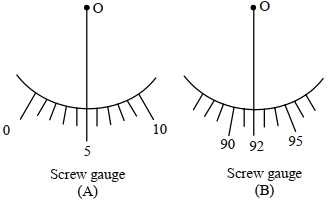
Student $A$ and Student $B$ used two screw gauges of equal pitch and $100$ equal circular divisions to measure the radius of a given wire. The actual value of the radius of the wire is $0.322\, {cm}$. The absolute value of the difference between the final circular scale readings observed by the students $A$ and $B$ is .... .

[Figure shows position of reference $'O'$ when jaws of screw gauge are closed]

Given pitch $=0.1 \,{cm}$.

An open pipe is in resonance in its $2^{nd}$ harmonic with tuning fork of frequency ${f_1}$. Now it is closed at one end. If the frequency of the tuning fork is increased slowly from ${f_1}$ then again a resonance is obtained with a frequency ${f_2}$. If in this case the pipe vibrates ${n^{th}}$ harmonics then
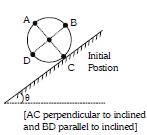
A solid sphere of mass $m$ , radius $R$ is released from rest on sufficient rough long inclined plane of inclination $\theta $ . Consider four points $A$ , $B$ , $C$ and $D$ on the sphere. After one revolution
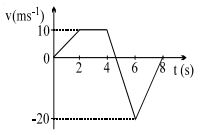
The figure shows a velocity-time graph of a particle moving along a straight line  If the particle starts from the position $x_0=-15\,m$ , then its position at $t=2\,s$ will be   ........ $m$
An object is projected in the air with initial velocity $u$ at an angle $\theta$. The projectile motion is such that the horizontal range $R$, is maximum. Another object is projected in the air with a horizontal range half of the range of first object. The initial velocity remains same in both the case. The value of the angle of projection, at which the second object is projected, will be $.......$ degree.
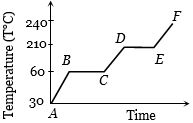
A solid substance is at $30°C$. To this substance heat energy is supplied at a constant rate. Then temperature versus time graph is as shown in the figure. The substance is in liquid state for the portion (of the graph)
An organ pipe $P_1$ closed at one end vibrating in its first overtone. Another pipe $P_2$ open at both ends is vibrating in its third overtone. They are in a resonance with a given tuning fork. The ratio of the length of $P_1$ to that of $P_2$ is :
$Assertion :$ Fahrenheit is the smallest unit measuring temperature.
$Reason :$ Fahrenheit was the first temperature scale used for measuring temperature.
Change of state from solid to vapour state without passing through the liquid state is called:
In a resonance pipe the first and second resonances are obtained at depths $22.7 cm$ and $70.2 cm$ respectively. What will be the end correction  ..... $cm$