MCQ
Change of state from solid to vapour state without passing through the liquid state is called:
  • A
    Regelation.
  • Sublimation.
  • C
    Condensation.
  • D
    Sedimentation.

Answer

Correct option: B.
Sublimation.

Need a full question paper?

Generate a complete, print-ready paper with questions like this in minutes — across 16+ boards, with answer keys.
Start Generating Free

Similar questions

If there is change of angular momentum from $1\,J$ to $5\, J$ in $5\, second$. Then the torque is :
Which of the following graphs represents the graphical relation between momentum $(p)$ and kinetic energy $(K)$ for a body in motion?
The motion of planets in the solar system is an example of the conservation of 
A particle is moving in a circle of radius $50 \mathrm{~cm}$ in such a way that at any instant the normal and tangential components of its acceleration are equal. If its speed at $t=0$ is $4 \mathrm{~m} / \mathrm{s}$, the time taken to complete the first revolution will be $\frac{1}{\alpha}\left[1-\mathrm{e}^{-2 \pi}\right] \mathrm{s}$, where $\alpha=$_______________.
Neglecting the air resistance, the time of flight of a projectile is determined by
You are holding a shallow circular container of radius $R$, filled with water to a height $h ( h < < R )$. When yon walk with speed $v$, it is seen that water starts spilling over. This happens due to the resonance of the periodic impulse given to the container (due to walking) with the oscillation of the water in the container. If the time period of water oscillating in the container is inversely proportional to $\sqrt{ h }$, then $v$ is proportional to
Four bodies $P, Q, R$ and $S$ are projected with equal velocities having angles of projection $15^o , 30^o , 45^o $  and $60^o $ with the horizontal respectively. The body having shortest range is
If the mean free path of atoms is doubled then the pressure of gas will become
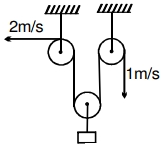
Find the velocity of the hanging block if the velocities of the free ends of the rope are as indicated in the figure.
The velocity of a particle is  $v=v_0 +gt+ft^2$. If its position is $x= 0$ at $t= 0 $, then its displacement after unit time ($t= 1$) is