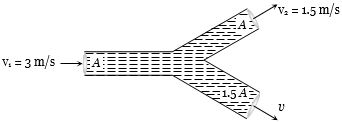
An incompressible liquid flows through a horizontal tube as shown in the following fig. Then the velocity $ v$ of the fluid is .......$m/s$
Medium


Download our appand get started for free
Experience the future of education. Simply download our apps or reach out to us for more information. Let's shape the future of learning together!No signup needed.*
Similar Questions
- 1A stone is projected vertically up from the bottom of a water tank. Assuming no water resistance it will go up and come down in same time but if water drag is present then the time it takes to go up, $t_{up}$ and the time it takes to come down, $t_{down}$ are related asView Solution
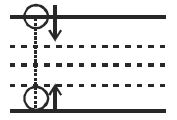
- 2The approximate depth of an ocean is $2700\,\, m.$ The compressibility of water is $45.4 \times 10^{-11} Pa^{-1}$ and density of water is $10^3 \,kg/m^3 $. What fractional compression of water will be obtained at the bottom of the ocean?View Solution
- 3View SolutionWith rise in temperature, density of a given body changes according to one of the following relations
- 4View SolutionThe pans of a physical balance are in equilibrium. Air is blown under the right hand pan; then the right hand pan will
- 5A submarine experiences a pressure of $5.05\times 10^6\,Pa$ at a depth of $d_1$ in a sea. When it goes further to a depth of $d_2,$ it experiences a pressure of $8.08\times 10^6\,Pa.$ Then $d_2 -d_1$ is approximately ........ $m$ (density of water $= 10^3\,kg/m^3$ and acceleration due to gravity $= 10\,ms^{-2}$ )View Solution
- 6View SolutionA solid cube and a solid sphere both made of same material are completely submerged in water but to different depths. The sphere and the cube have same surface area. The buoyant force is
- 7A large drop of oil (density $0.8\,g / cm ^3$ and viscosity $\eta_0$) floats up through a column of another liquid (density $1.2\,g / cm ^3$ and viscosity $\eta_L$ ). Assuming that the two liquids do not mix, the velocity with which the oil drop rises will depend on.View Solution
- 8$Assertion :$ A thin stainless steel needle can lay floating on a still water surface.View Solution
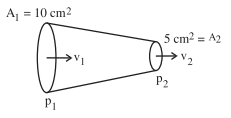
$Reason :$ Any object floats when the buoyancy force balances the weight of the object - 9Glycerine of density $1.25 \times 10^3\,kg\,m ^{-3}$ is flowing through the conical section of pipe. The area of cross-section of the pipe at its ends is $10\,cm ^2$ and $5\,cm ^2$ and pressure drop across its length is $3\,Nm ^{-2}$. The rate of flow of glycerine through the pipe is $x \times 10^{-5} m ^3 s ^{-1}$. The value of $x$ is $..............$.View Solution
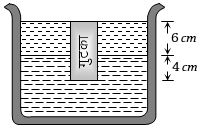
- 10A cubical block of wood $10 \,cm$ on a side floats at the interface between oil and water with its lower surface horizontal and $4\, cm$ below the interface. The density of oil is $0.6gc{m^{ - 3}}$. The mass of block is ...... $gm$View Solution