An incompressible liquid is kept in a container having a weightless piston with a hole. A capillary tube of inner radius $0.1 \mathrm{~mm}$ is dipped vertically into the liquid through the airtight piston hole, as shown in the figure. The air in the container is isothermally compressed from its original volume $V_0$ to $\frac{100}{101} V_0$ with the movable piston. Considering air as an ideal gas, the height $(h)$ of the liquid column in the capillary above the liquid level in $\mathrm{cm}$ is. . . . . . .
[Given: Surface tension of the liquid is $0.075 \mathrm{Nm}^{-1}$, atmospheric pressure is $10^5 \mathrm{~N} \mathrm{~m}^{-2}$, acceleration due to gravity $(g)$ is $10 \mathrm{~m} \mathrm{~s}^{-2}$, density of the liquid is $10^3 \mathrm{~kg} \mathrm{~m}^{-3}$ and contact angle of capillary surface with the liquid is zero]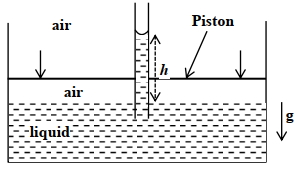
IIT 2023, Medium
Download our app for free and get started
(image)
$h_0=\frac{2 T \cos \theta}{\rho g r}=\frac{2 \times 0.075 \times 1}{10^3 \times 10 \times 10^{-4}}=15 \mathrm{~cm}$
$P_0 V_0=P \frac{100 V_0}{101} \Rightarrow P=\frac{101}{100} \mathrm{P}_0$
$P_0-\frac{2 T \cos \theta}{\mathrm{r}}+\rho g \mathrm{gh}=\mathrm{P}=\frac{101}{100} \mathrm{P}_0 $
$\Rightarrow-\rho g \mathrm{~h}_0+\rho g \mathrm{gh}=\frac{\mathrm{P}_0}{100}$
$\Rightarrow \mathrm{h}=\mathrm{h}_0+\frac{\mathrm{P}_0}{100 \mathrm{\rho g}}$
$=15 \mathrm{~cm}+\frac{10^5}{100 \times 10^3 \times 10}=25 \mathrm{~cm}$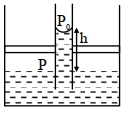

Download our appand get started for free
Experience the future of education. Simply download our apps or reach out to us for more information. Let's shape the future of learning together!No signup needed.*
Similar Questions
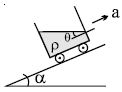
- 1A fluid container is containing a liquid of density $\rho $ is accelerating upward with acceleration a along the inclined place of inclination $\alpha$ as shown. Then the angle of inclination $ \theta $ of free surface is :View Solution
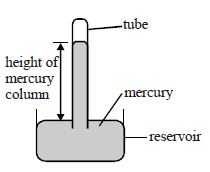
- 2View SolutionThe diagram shows a simple mercury barometer.Which of the following does not cause the height of the mercury column to vary ?
- 3A horizontal right angle pipe bend has crosssectional area $=$ $10 $ $cm^2$ and water flows through it at speed $=$ $20$ $m/s$. The force on the pipe bend due to the turning of water is ........ $N$View Solution
- 4$Assertion :$ Falling raindrops acquire a terminal velocity.View Solution
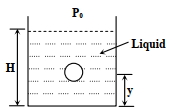
$Reason :$ A constant force in the direction of motion and a velocity dependent force opposite to the direction of motion, always result in the acquisition of terminal velocity. - 5A small spherical monoatomic ideal gas bubble $\left(\gamma=\frac{5}{3}\right)$ is trapped inside a liquid of density $\rho_{\ell}$ (see figure). Assume that the bubble does not exchange any heat with the liquid. The bubble contains n moles of gas. The temperature of the gas when the bubble is at the bottom is $\mathrm{T}_0$, the height of the liquid is $\mathrm{H}$ and the atmospheric pressure is $\mathrm{P}_0$ (Neglect surface tension).View Solution
Figure: $Image$
$1.$ As the bubble moves upwards, besides the buoyancy force the following forces are acting on it
$(A)$ Only the force of gravity
$(B)$ The force due to gravity and the force due to the pressure of the liquid
$(C)$ The force due to gravity, the force due to the pressure of the liquid and the force due to viscosity of the liquid
$(D)$ The force due to gravity and the force due to viscosity of the liquid
$2.$ When the gas bubble is at a height $\mathrm{y}$ from the bottom, its temperature is
$(A)$ $\mathrm{T}_0\left(\frac{\mathrm{P}_0+\rho_0 \mathrm{gH}}{\mathrm{P}_0+\rho_t \mathrm{gy}}\right)^{2 / 5}$
$(B)$ $T_0\left(\frac{P_0+\rho_t g(H-y)}{P_0+\rho_t g H}\right)^{2 / 5}$
$(C)$ $\mathrm{T}_0\left(\frac{\mathrm{P}_0+\rho_t \mathrm{gH}}{\mathrm{P}_0+\rho_t \mathrm{gy}}\right)^{3 / 5}$
$(D)$ $T_0\left(\frac{P_0+\rho_t g(H-y)}{P_0+\rho_t g H}\right)^{3 / 5}$
$3.$ The buoyancy force acting on the gas bubble is (Assume $R$ is the universal gas constant)
$(A)$ $\rho_t \mathrm{nRgT}_0 \frac{\left(\mathrm{P}_0+\rho_t \mathrm{gH}\right)^{2 / 5}}{\left(\mathrm{P}_0+\rho_t \mathrm{gy}\right)^{7 / 5}}$
$(B)$ $\frac{\rho_{\ell} \mathrm{nRgT}_0}{\left(\mathrm{P}_0+\rho_{\ell} \mathrm{gH}\right)^{2 / 5}\left[\mathrm{P}_0+\rho_{\ell} \mathrm{g}(\mathrm{H}-\mathrm{y})\right]^{3 / 5}}$
$(C)$ $\rho_t \mathrm{nRgT} \frac{\left(\mathrm{P}_0+\rho_t g \mathrm{H}\right)^{3 / 5}}{\left(\mathrm{P}_0+\rho_t g \mathrm{~g}\right)^{8 / 5}}$
$(D)$ $\frac{\rho_{\ell} \mathrm{nRgT}_0}{\left(\mathrm{P}_0+\rho_{\ell} \mathrm{gH}\right)^{3 / 5}\left[\mathrm{P}_0+\rho_t \mathrm{~g}(\mathrm{H}-\mathrm{y})\right]^{2 / 5}}$
Give the answer question $1,2,$ and $3.$
- 6View SolutionBernoulli's principle does not explain
- 7A liquid of density $750\,kgm ^{-3}$ flows smoothly through a horizontal pipe that tapers in crosssectional area from $A _{1}=1.2 \times 10^{-2}\,m ^{2}$ to $A_{2}=\frac{A_{1}}{2}$. The pressure difference between the wide and narrow sections of the pipe is $4500\,Pa$. The rate of flow of liquid is________$\times 10^{-3}\,m ^{3} s ^{-1}$View Solution
- 8View SolutionIncrease in pressure at one point of the enclosed liquid in equilibrium of rest is transmitted equally to all other points of liquid. This is as per ...........
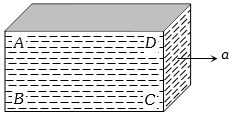
- 9A closed rectangular tank is completely filled with water and is accelerated horizontally with an acceleration a towards right. Pressure is $(i)$ maximum at, and $ (ii) $ minimum atView Solution
- 10The velocity of upper layer of water in a river is $36 kmh ^{-1}$. Shearing stress between horizontal layers of water is $10^{-3} Nm ^{-2}$. Depth of the river is $m$. (Co-efficiency of viscosity of water is $10^{-2} \,Pa . s$ )View Solution