Question
An inductor-coil of inductance 20mH having resistance $10\Omega$ is joined to an ideal battery of emf 5.0V. Find the rate of chenge of the induced emf at:
  1. t = 0
  2. t = 10ms
  3. t = 1.0s.

Answer

$\text{L}=20\text{mH} ; \ \text{e}=5.0\text{V},\text{R}=10 \ \Omega$$\tau=\frac{\text{L}}{\text{R}}=\frac{20\times10^{-3}}{10},\text{i}_0=\frac{5}{10}$
$\text{i}=\text{i}_0(1-\text{e}^{\frac{\text{t}}{\tau}})^2$
$\Rightarrow \ \text{i}=\text{i}_0-\text{i}_0\text{e}^{\frac{\text{-t}}{\tau^2}}$
$\Rightarrow\text{iR}=\text{i}_0\text{R}-\text{i}_0\text{R}\text{e}^{\frac{\text{-t}}{\tau^2}}$
  1. $10\times\frac{\text{di}}{\text{dt}}=\frac{\text{d}}{\text{dt}}\text{i}_0\text{R}+10\times\frac{5}{10}\times\frac{10}{20\times10^{-3}}\times\text{e}^{0\times\frac{10}{2\times10^{-2}}}$
$\frac{5}{2}\times10^{-3}\times1=\frac{5000}{2}=2500=2.5\times10^{-3}\text{V}/\text{s}.$
  1. $\frac{\text{Rdi}}{\text{dt}}=\text{R}\times\text{i}^0\times\frac{1}{\tau}\times\text{e}^{\frac{\text{-t}}{\tau}}$
$\text{t}=10\text{ms}=10\times10^{-3}\text{s}$
$\frac{\text{dE}}{\text{dt}}=10\times\frac{5}{10}\times\frac{10}{20\times10^{-3}}\times\text{e}^{-0.01\times\frac{2}{10^{-2}}}$
$=16.844=17\text{V}/'$
  1. $\text{For} \ \text{t} =1\text{s}$
$\frac{\text{dE}}{\text{dt}}=\frac{\text{Rdi}}{\text{dt}}=\frac{5}{2}10^3\times\text{e}^{\frac{10}{2\times10^{-2}}}=0.00\text{V}/\text{s}.$

Need a full question paper?

Generate a complete, print-ready paper with questions like this in minutes — across 16+ boards, with answer keys.
Start Generating Free

Similar questions

A satellite orbits the earth at a height of 400 km above the surface. How much energy must be expended to rocket the satellite out of the earth's gravitational influence? Mass of the satellite $=200 \mathrm{~kg}$; mass of the earth $=6.0 \times$ $10^{24} \mathrm{~kg}$; radius of the earth $=6.4 \times 10^6 \mathrm{~m} ; \mathrm{G}=6.67 \times 10^{-11} \mathrm{~N} \mathrm{~m}^2 \mathrm{~kg}^{-2}$.
A metre scale is made up of steel and measures correct length at $16^{\circ} \mathrm{C}$. What will be the percentage error if this scale is used:
a. On a summer day when the temperature is $46^{\circ} \mathrm{C}$.
b. On a winter day when the temperature is $6^{\circ} \mathrm{C}$ ? Coefficient of linear expansion of steel $=11 \times 10^{-60} \mathrm{C}^{-1}$.
An aluminium can of cylindrical shape contains $500cm^3$ of water. The area of the inner cross section of the can is $125cm^2$. All measurements refer to $10^\circ C$. Find the rise in the water level if the temperature increases to $80^\circ C$. The coefficient of linear expansion of aluminium = $23 \times {10^{-6}} { ^\circ C}^{-1}$ and the average coefficient of volume expansion of water = $3.2 \times {10^{-4}} { ^\circ C}^{-1}$ respectively.
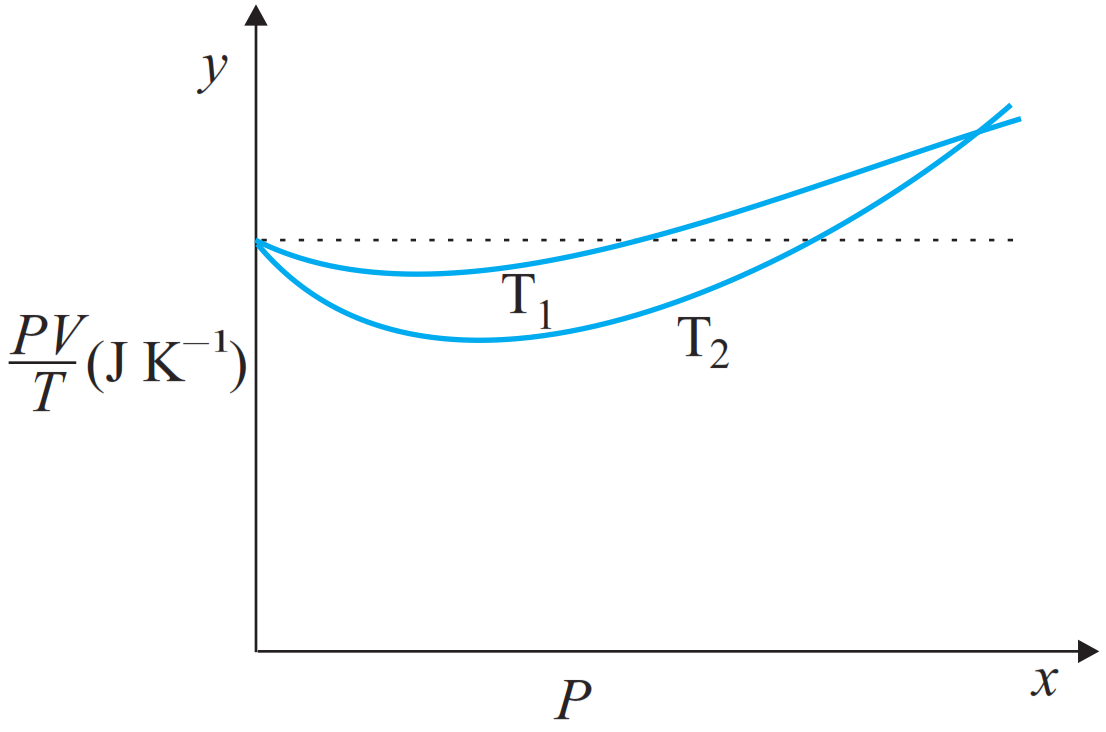
Shows plot of $\frac{\text{PV}}{\text{T}}$ versus P for $1.00 \times 10^{-3}kg$ of oxygen gas at two different temperatures: What is the value of $\frac{\text{PV}}{\text{T}}$ where the curves meet on the y-axis?
A stone of mass m tied to the end of a string revolves in a vertical circle of radius R. The net forces at the lowest and highest points of the circle directed vertically downwards are: [Choose the correct alternative]
 
Lowest Point
Highest Point
(a)
$mg - T_1$
$mg + T_2$
(b)
$mg + T_1$
$mg - T_2$
(c)
$mg + T_1 - (mv_1^2)/R$
$mg - T_2 + (mv_1^2)/R$
(d)
$mg - T_1 - (mv_1^2)/R$
$mg + T_2 + (mv_1^2)/R$
$T_1$ and $v_1$ denote the tension and speed at the lowest point. $T_2$ and $v_2$ denote corresponding values at the highest point.
A wire of length L and radius r is clamped rigidly at one end. When the other end of the wire is pulled by a force f, its length increases by l. Another wire of the same material of length 2L and radius 2r, is pulled by a force 2f. Find the increase in length of this wire.
Find at what temperature the velocity of sound is air will be $1\frac{1}{2}$ times the velocity at 11°C.
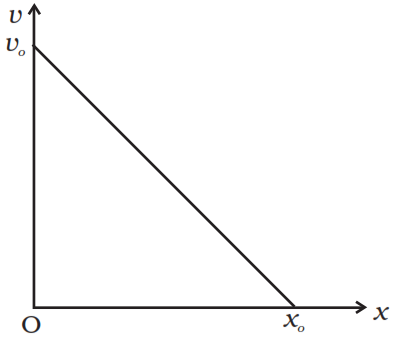
The velocity-displacement graph of a particle is shown in Fig.
  1. Write the relation between v and x.
  2. Obtain the relation between acceleration and displacement and plot it.
Does the escape speed of a body from the earth depend on (a) the mass of the body, (b) the location from where it is projected, (c) the direction of projection, (d) the height of the location from where the body is launched?
A uniform rod of mass m and length l is struck at an end by a force F perpendicular to the rod for a short time interval t. Calculate:
  1. The speed of the centre of mass.
  2. The angular speed of the rod about the centre of mass.
  3. The kinetic energy of the rod.
  4. The angular momentum of the rod about the centre of mass after the force has stopped to act. Assume that t is so small that the rod does not appreciably change its direction while the force acts.