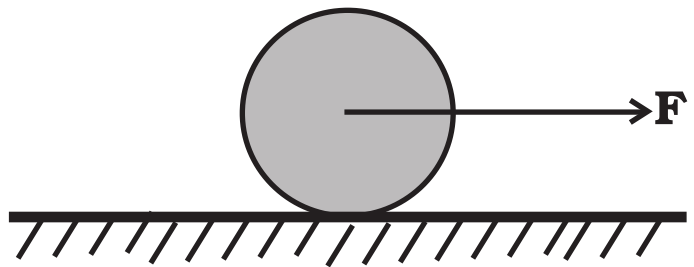
A uniform rod of mass m and length l is struck at an end by a force F perpendicular to the rod for a short time interval t. Calculate:
- The speed of the centre of mass.
- The angular speed of the rod about the centre of mass.
- The kinetic energy of the rod.
- The angular momentum of the rod about the centre of mass after the force has stopped to act. Assume that t is so small that the rod does not appreciably change its direction while the force acts.
Download our app for free and get started
A uniform rod of mass m length $\ell$ is struck at an end by a force F. $\perp$ to the rod for a short time t:
$\Rightarrow\text{v}=\frac{\text{Ft}}{\text{m}}$
$\Rightarrow\Big(\frac{\text{m}\ell}{12}\Big)\times\omega=\Big(\frac{1}{2}\Big)\times\text{mv}$
$\Rightarrow\Big(\frac{\text{m}\ell}{12}\Big)\times\omega=\Big(\frac{1}{2}\Big)\ell\omega^2$
$\Rightarrow\omega=\frac{\text{m}\ell}{6\text{Ft}}$
$=\Big(\frac{1}{2}\Big)\times\text{m}\times\Big(\frac{\text{F}^2\text{t}^2}{\text{m}^2}\Big)+\Big(\frac{1}{2}\Big)\times\Big(\frac{\text{m}\ell^2}{12}\Big)\Big[36\times\Big(\frac{\text{F}^2\text{t}^2}{\text{m}^2\ell^2}\Big)\Big]$
$=\frac{\text{F}^2\text{t}^2}{\text{2m}}+\frac{3}{2}\Big(\frac{\text{F}^2\text{t}^2}{\text{m}}\Big)=2\Big(\frac{\text{F}^2\text{t}^2}{\text{m}}\Big)$
- Speed of the centre of mass:
$\Rightarrow\text{v}=\frac{\text{Ft}}{\text{m}}$
- The angular speed of the rod about the centre of mass:
$\Rightarrow\Big(\frac{\text{m}\ell}{12}\Big)\times\omega=\Big(\frac{1}{2}\Big)\times\text{mv}$
$\Rightarrow\Big(\frac{\text{m}\ell}{12}\Big)\times\omega=\Big(\frac{1}{2}\Big)\ell\omega^2$
$\Rightarrow\omega=\frac{\text{m}\ell}{6\text{Ft}}$
- $\text{K.E.}=\Big(\frac{1}{2}\Big)\text{mv}^2+\Big(\frac{1}{2}\Big)\ell\omega^2$
$=\Big(\frac{1}{2}\Big)\times\text{m}\times\Big(\frac{\text{F}^2\text{t}^2}{\text{m}^2}\Big)+\Big(\frac{1}{2}\Big)\times\Big(\frac{\text{m}\ell^2}{12}\Big)\Big[36\times\Big(\frac{\text{F}^2\text{t}^2}{\text{m}^2\ell^2}\Big)\Big]$
$=\frac{\text{F}^2\text{t}^2}{\text{2m}}+\frac{3}{2}\Big(\frac{\text{F}^2\text{t}^2}{\text{m}}\Big)=2\Big(\frac{\text{F}^2\text{t}^2}{\text{m}}\Big)$
- Angular momentum about the centre of mass:

Download our appand get started for free
Experience the future of education. Simply download our apps or reach out to us for more information. Let's shape the future of learning together!No signup needed.*
Similar Questions
- 1A uniform wheel of radius R is set into rotation about its axis at an angular speed $\omega.$ This rotating wheel is now placed on a rough horizontal surface with its axis horizontal. Because of friction at the contact, the wheel accelerates forward and its rotation decelerates till the wheel starts pure rolling on the surface. Find the linear speed of the wheel after it starts pure rolling.View Solution
- 2View SolutionA disc of radius R is cut out from a larger disc of radius 2R in such a way that the edge of the hole touches the edge of the disc. Locate the centre of mass of the residual disc.
- 3View SolutionA metal bar 70 cm long and 4.00 kg in mass supported on two knifeedges placed 10 cm from each end. A 6.00 kg load is suspended at 30 cm from one end. Find the reactions at the knife-edges. (Assume the bar to be of uniform cross section and homogeneous.)
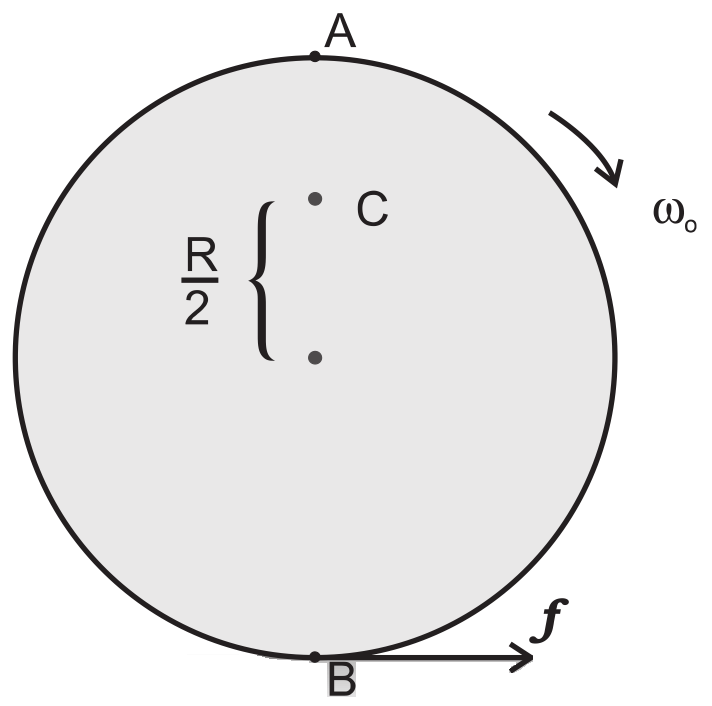
- 4A disc rotating about its axis with angular speed $\omega_0$ is placed lightly (without any translational push) on a perfectly frictionless table. The radius of the disc is R. What are the linear velocities of the points A, B and C on the disc shown in will the disc roll in the direction indicated?View Solution
- 5View SolutionTwo particles, each of mass m and speed v, travel in opposite directions along parallel lines separated by a distance d. Show that the angular momentum vector of the two particle system is the same whatever be the point about which the angular momentum is taken.
- 6A solid sphere of mass 0.50kg is kept on a horizontal surface. The coefficient of static friction between the surfaces in contact is $\frac{2}{7}.$ What maximum force can be applied at the highest point in the horizontal direction so that the sphere does not slip on the surface?View Solution
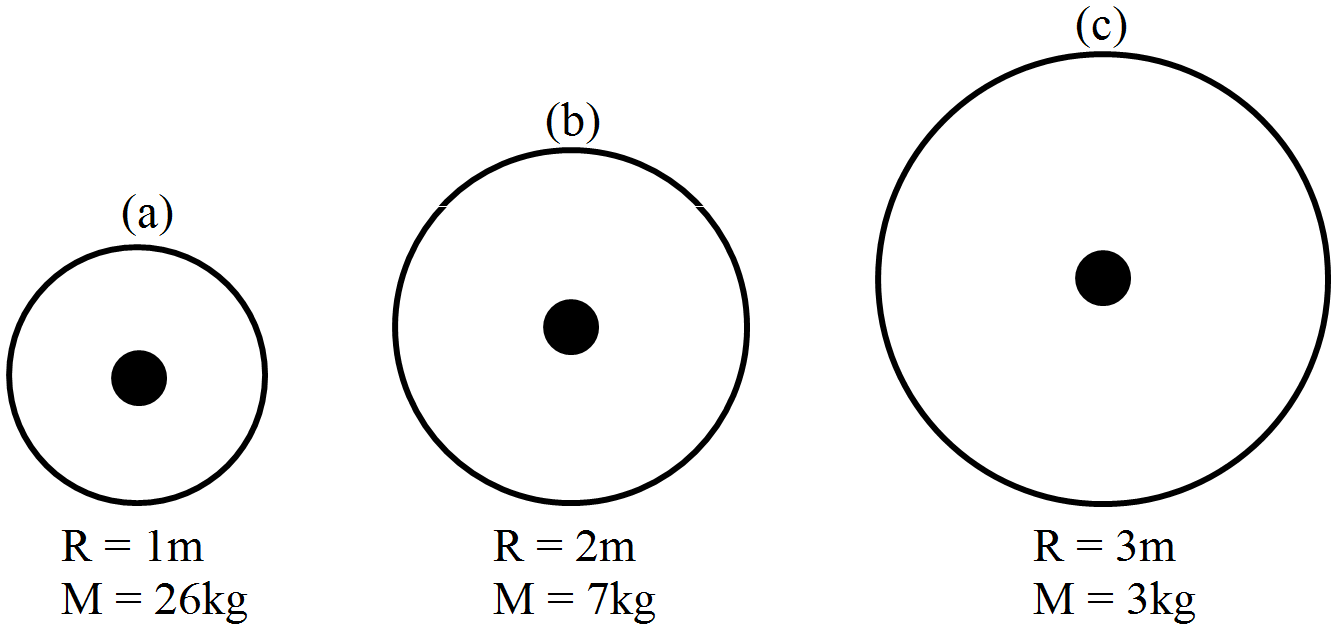
- 7View SolutionFigure shows three uniform discs, along with their radii R and masses M. Rank the discs according to their rotational inertia about their central axes, greatest first.
- 8Prove the result that the velocity v of translation of a rolling body (like a ring, disc, cylinder or sphere) at the bottom of an inclined plane of height h given by $\text{v}^2=\frac{2\text{gh}}{\big(1+\frac{\text{K}^2}{\text{R}^2}\big)}$ using dynamical consideration. Note K is the radius of gyration of the body about its symmetry axis, and R is the radius of the body. The body starts from rest at the top of the plane.View Solution
- 9Prove the result that the velocity v of translation of a rolling body (like a ring, disc, cylinder or sphere) at the bottom of an inclined plane of a height h is given by $\text{v}^2=\frac{2\text{gh}}{\Big(\frac{1+\text{k}^2}{\text{R}^2}\Big)}$ using dynamical consideration (i.e. by consideration of forces and torques).View Solution
Note: k is the radius of gyration of the body about its symmetry axis, and R is the radius of the body. The body starts from rest at the top of the plane. - 10A uniform disc of radius R, is resting on a table on its rim.The coefficient of friction between disc and table is $\mu.$Now the disc is pulled with a force F as shown in the figure. What is the maximum value of F for which the disc rolls without slipping?View Solution