MCQ
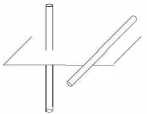
An infinite non-conducting sheet has a surface charge density $\sigma  = 0.10\, \mu C/m^2$ on one side. How far apart are equipotential surfaces whose potentials differ by $50\, V$
  • A
    $8.85\, m$
  • B
    $8.85\, cm$
  • $8.85\, mm$
  • D
    $88.5\, mm$

Answer

Correct option: C.
$8.85\, mm$
c
(c) $E = \frac{V}{d}$ $==>$ $\frac{\sigma }{{2{\varepsilon _0}}} = \frac{V}{d}$ $==>$ $d = \frac{{V \times 2{\varepsilon _0}}}{\sigma }$ $ = \frac{{50 \times 2 \times 8.85 \times {{10}^{ - 12}}}}{{0.1 \times {{10}^{ - 6}}}}$
$= 8.85 \times 10^{-3} \,m = 8.88\, mm$

Need a full question paper?

Generate a complete, print-ready paper with questions like this in minutes — across 16+ boards, with answer keys.
Start Generating Free

Similar questions

The magnetic force acting on a charged particle of charge $-2\, \mu  C$ in a magnetic field of $2\, T$ acting in $y$ direction, when the particle velocity is $(2i + 3 j) \times  10^6\,\, m/s$ is
The variation of magnetic susceptibility (x) with magnetising field for a paramagnetic substance is
The strength and direction of the magnetic field depends on $.......$
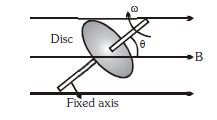
A disc of radius $r$ and carrying positive charge $q$ is rotating with an angular speed $l$ in a uniform magnetic field $B$ about a fixed axis as shown in figure, such that angle made by axis of disc with magnetic field is $\theta $. Torque applied by axis on the disc is 
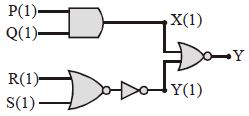
The circuit diagram shows a logic combination with the states of outputs $X, Y$ and $Z$ given for inputs $P, Q, R$ and $S$ all at state $1$. When input $P$ and $R$ change to  state $0$ with inputs $Q$ and $S$ still at $1$, the states of outputs $X, Y$ and $Z$ change to
In the line spectra of hydrogen atom, difference between the largest and the shortest wavelengths of the Lyman series is $304\,\mathring {A}.$ The corresponding difference for the Paschan series in $\mathring {A}$ is
A beam of monoenergetic electrons, which have been accelerated from rest by a potential $U$, is used to form an interference pattern in a Young's double slit experiment. The electrons are now accelerated by potential $4 U$. Then, the fringe width
Two parallel wires in free space are $10\, cm$ apart and each carries a current of $10\, A$ in the same direction. The force one wire exerts on the other per metre of length is
A ray of light is incident on a transparent glass slab of refractive index $1.62.$ The reflected and the refracted rays are mutually perpendicular. The angle of incidence is
Two mutually perpendicular infinitely long straight conductors carrying uniformly distributed charges of linear densities $\lambda_{1}$ and $\lambda_{2}$ are positioned at a distance $r$ from each other. Force between the conductors depends on $r$ as