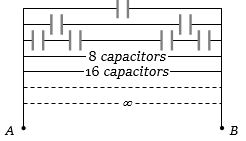
An infinite number of identical capacitors each of capacitance $1\,\mu F$ are connected as in adjoining figure. Then the equivalent capacitance between $A$ and $B$ is......$\mu F$
AIIMS 2018, Medium
Download our app for free and get started
(b)This combination forms a $G.P.$ $S = 1 + \frac{1}{2} + \frac{1}{4} + \frac{1}{8}......$
Sum of infinite $G.P.$ $S = \frac{a}{{1 - r}}$
Here $a$ $=$ first term $= 1$ and $r$ $=$ common ratio $ = \frac{1}{2}$
$==>$ $S = \frac{1}{{1 - \frac{1}{2}}} = 2$ $==>$ ${C_{eq}} = 2\,\mu F$
Sum of infinite $G.P.$ $S = \frac{a}{{1 - r}}$
Here $a$ $=$ first term $= 1$ and $r$ $=$ common ratio $ = \frac{1}{2}$
$==>$ $S = \frac{1}{{1 - \frac{1}{2}}} = 2$ $==>$ ${C_{eq}} = 2\,\mu F$

Download our appand get started for free
Experience the future of education. Simply download our apps or reach out to us for more information. Let's shape the future of learning together!No signup needed.*
Similar Questions
- 1View SolutionAn insulator plate is passed between the plates of a capacitor. Then the displacement current
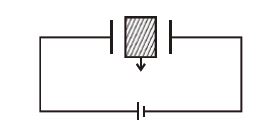
- 2A parallel plate air capacitor has a capacitance $C$. When it is half filled with a dielectric of dielectric constant $5$, the percentage increase in the capacitance will be......$\%$View Solution
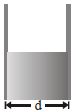
- 3In a hollow spherical shell potential $(V)$ changes with respect to distance $(r)$ from centreView Solution
- 4A capacitor $C$ is fully charged with voltage $V _{0}$ After disconnecting the voltage source, it is connected in parallel with another uncharged capacitor of capacitance $\frac{ C }{2} .$ The energy loss in the process after the charge is distributed between the two capacitors is$.........$$CV _{0}^{2}$View Solution
- 5When a proton is accelerated through $1\,V$, then its kinetic energy will be.....$eV$View Solution
- 6Two small spheres each carrying a charge $q$ are placed $r$ metre apart. If one of the spheres is taken around the other one in a circular path of radius $r$, the work done will be equal toView Solution
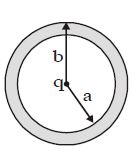
- 7In the figure shown the electric potential energy of the system is: ( $q$ is at the centre of the conducting neutral spherical shell of inner radius $a$ and outer radius $b$ )View Solution
- 8Three charges $2 q,-q$ and $-q$ are located at the vertices of an equilateral triangle. At the center of the triangleView Solution
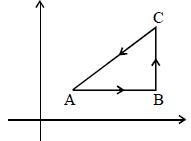
- 9As shown in figure, on bringing a charge $Q$ from point $A$ to $B$ and from $B$ to $C$, the work done are $2\, joule$ and $-3\, joule$ respectively. The work done to bring the charge from $C$ to $A$ isView Solution
- 10A proton is about $1840$ times heavier than an electron. When it is accelerated by a potential difference of $1\, kV$, its kinetic energy will be......$keV$View Solution