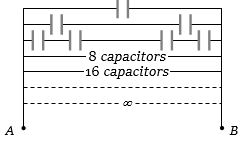
An infinite number of identical capacitors each of capacitance $1\,\mu F$ are connected as in adjoining figure. Then the equivalent capacitance between $A$ and $B$ is......$\mu F$
AIIMS 2018, Medium


Download our appand get started for free
Experience the future of education. Simply download our apps or reach out to us for more information. Let's shape the future of learning together!No signup needed.*
Similar Questions
- 1View SolutionThe angle between the electric lines of force and the equipotential surface is
- 2A parallel plate capacitor of plate area $A$ and plate seperation $d$ is charged to potential difference $V$ and then the battery is disconnected. Aslab of dielectric constant $K$ is then inserted between the plates of the capacitor so as to fill the space between the plates. If $Q, E$ and $W$ denote respectively, the magnitude of charge on each plate, the electric field between the plates (after the slab is inserted) and the work done on the system, in question, in the process of inserting the slab, thenView Solution
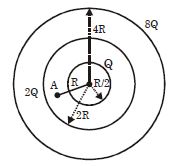
- 3Three charged concentric nonconducting shells are given as shown in figure. Find the potential at point $A$View Solution
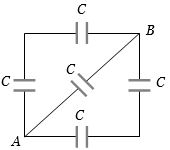
- 4In the figure shown, the effective capacitance between the points $A$ and $B$, if each has capacitance $C$, isView Solution
- 5A hollow metallic sphere of radius $R$ is given a charge $Q$. Then the potential at the centre isView Solution
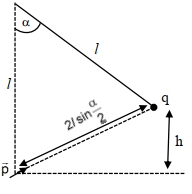
- 6If ${q}_{{f}}$ is the free charge on the capacitor plates and ${q}_{{b}}$ is the bound charge on the dielectric slab of dielectric constant $k$ placed between the capacitor plates, then bound charge $q_{b}$ can be expressed asView Solution
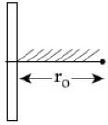
- 7A positive point charge is released from rest at a distance $r_0$ from a positive line charge with uniform density. The speed $(v)$ of the point charge, as a function of instantaneous distance $r$ from line charge, is proportional toView Solution
- 8A capacitor of capacity $C$ has charge $Q$ and stored energy is $W$. If the charge is increased to $2Q$, the stored energy will beView Solution
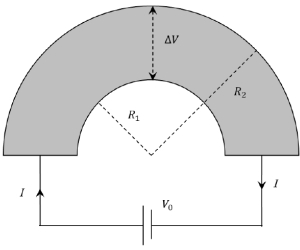
- 9Shown in the figure is a semicircular metallic strip that has thickness $t$ and resistivity $\rho$. Its inner radius is $R_1$ and outer radius is $R_2$. If a voltage $V_0$ is applied between its two ends, a current $I$ flows in it. In addition, it is observed that a transverse voltage $\Delta V$ develops between its inner and outer surfaces due to purely kinetic effects of moving electrons (ignore any role of the magnetic field due to the current). Then (figure is schematic and not drawn to scale)-View Solution
$(A)$ $I =\frac{V_0 t}{\pi \rho} \ln \left(\frac{R_2}{R_1}\right)$
$(B)$ the outer surface is at a higher voltage than the inner surface
$(C)$ the outer surface is at a lower voltage than the inner surface
$(D)$ $\Delta V \propto I ^2$
- 10A point charge $q$ of mass $m$ is suspended vertically by a string of length $l$. A point dipole of dipole moment $\overrightarrow{ p }$ is now brought towards $q$ from infinity so that the charge moves away. The final equilibrium position of the system including the direction of the dipole, the angles and distances is shown in the figure below. If the work done in bringing the dipole to this position is $N \times( mgh )$, where $g$ is the acceleration due to gravity, then the value of $N$ is. . . . . . (Note that for three coplanar forces keeping a point mass in equilibrium, $\frac{F}{\sin \theta}$ is the same for all forces, where $F$ is any one of the forces and $\theta$ is the angle between the other two forces)View Solution