MCQ
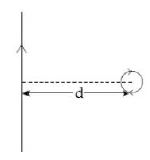
An infinitely long current carrying wire and a small current carrying loop are in the plane of the paper as shown. the radius of the loop is $a$ and distance of its centre from the wire is $d (d >> a)$. If the loop applies a force $F$ on the wire then
  • A
    $F = 0$
  • B
    $F \propto \left( {\frac{a}{d}} \right)$
  • C
    $F \propto \left( {\frac{a^2}{d^3}} \right)$
  • $F \propto {\left( {\frac{a}{d}} \right)^2}$
Answer

Correct option: D.
$F \propto {\left( {\frac{a}{d}} \right)^2}$
d
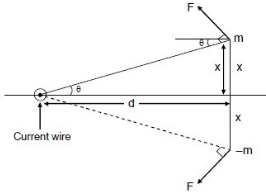
Force on one pole

$F = \frac{{m{\mu _0}I}}{{2\pi \sqrt {{d^2} + {x^2}} }}$

$m=$ pole strength

Total force $=2 F \sin \theta$

$=\frac{2 \times \mu_{0} \operatorname{Im} \times x}{2 \pi \sqrt{d^{2}+a^{2}} \sqrt{d^{2}+a^{2}}}=\frac{\mu_{0} \operatorname{Im} x}{\pi\left[d^{2}+a^{2}\right]}$

$=m 2 x=M=I \pi a^{2}$

Total force $=\frac{\mu_{0} I a^{2}}{2\left(d^{2}+a^{2}\right)}$

$\approx \frac{\mu_{0} I a^{2}}{2 d^{2}} \quad[\because d>>a]$

Need a full question paper?

Generate a complete, print-ready paper with questions like this in minutes — across 16+ boards, with answer keys.

Start Generating Free

Similar questions

Which of the following cannot be polarized?
Which color band in the resistor is having highest tolerance?
Two coaxial solenoids of different radii carry current $I$ in the same direction. Let $\;{\overrightarrow {\;F} _1}$ be the magnetic force on the inner solenoid due to the outer one and $\;{\overrightarrow {\;F} _2}$ be the magnetic force on the outer solenoid due to the inner one. Then
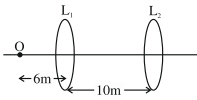
A point object, $O$ is placed in front of two thin symmetrical coaxial convex lenses $L _1$ and $L _2$ with focal length $24\,cm$ and $9\,cm$ respectively. The distance between two lenses is $10\,cm$ and the object is placed $6\,cm$ away from lens $L _1$ as shown in the figure. The distance between the object and the image formed by the system of two lenses is .........$cm$
A convex lens has $9 cm$ focal length and a concave lens has $-18 cm$ focal length. The focal length of the combination in contact will be.....$cm$
Assertion : Bohr had to postulate that the electrons in stationary orbits around the nucleus do not radiate.
Reason : According to classical physics all moving electrons radiate.
Electric field lines of force:
Speed of electromagnetic waves is the same:
When light travels from glass to air, the incident angle is $\theta_1$ and the refracted angle is $\theta_2$. The true relation is
A parallel beam of monochromatic unpolarised light is incident on a transparent dielectric plate of refractive index  $\frac {1}{\sqrt 3}$ . The reflected beam is completely polarised. Then the angle of incidence is....$^o$