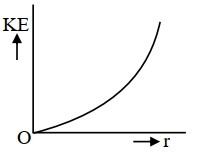
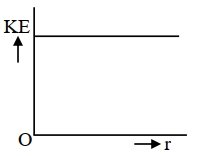
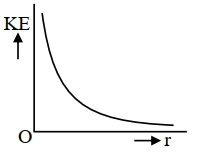
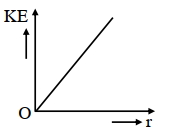
- A

- ✓

- C

- D


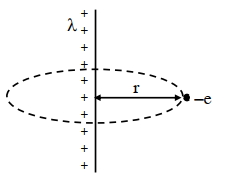
Force of electron $\Rightarrow \mathrm{F}=\mathrm{eE}$
$F=e\left(\frac{2 k \lambda}{r}\right)$
$F=\frac{2 k \lambda e}{r}$
This force will provide required centripetal force
$\mathrm{F} =\frac{\mathrm{mv}^2}{\mathrm{r}}=\frac{2 \mathrm{k} \lambda \mathrm{e}}{\mathrm{r}}$
$\mathrm{v} =\sqrt{\frac{2 \mathrm{k} \lambda \mathrm{e}}{\mathrm{m}}}$
$\mathrm{KE} =\frac{1}{2} \mathrm{mv}^2=\frac{1}{2} \mathrm{~m}\left(\frac{2 \mathrm{k} \lambda \mathrm{e}}{\mathrm{m}}\right)$
$=\mathrm{k} \lambda \mathrm{e}$
This is constant so option $(2)$ is correct.
Generate a complete, print-ready paper with questions like this in minutes — across 16+ boards, with answer keys.
$A.$ The electron will experience magnetic force along the axis of the solenoid.
$B.$ The electron will not experience magnetic force.
$C.$ The electron will continue to move along the axis of the solenoid.
$D.$ The electron will be accelerated along the axis of the solenoid.
$E.$ The electron will follow parabolic path-inside the solenoid.
Choose the correct answer from the options given below: