Question
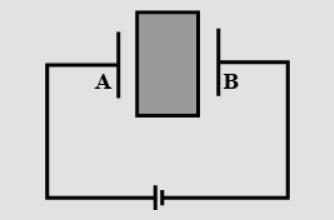
An insulator plate is passed between the plates of a capacitor. Then, current:

Answer

  1. First flows from B to A and then from A to B

Need a full question paper?

Generate a complete, print-ready paper with questions like this in minutes — across 16+ boards, with answer keys.
Start Generating Free

Similar questions

Ionization potential of hydrogen atom is 13.6 V.
Hydrogen atoms in the ground state are excited by monochromatic radiation of photon energy 12.1 eV. The spectral lines emitted by hydrogen atoms according to Bohr's theory will be(a) One   (b) Two(c) Three(d) Four
       
Sixty-four drops are jointed together to form a bigger drop. If each small drop has a capacitance C, a potential V, and a charge q, then the capacitance of the bigger drop will be(a) C (b) 4C(c) 16C    (d) 64C
       
Identify the type of conductor in which the variation of current with potential difference may depend upon the sign of the potential difference applied.
The conductivity of a metal decreases with the increase in temperature on account of:
An oscillator is nothing but an amplifier with(a) Positive feed back(b) Large gain(c) No feedback(d) Negative feedback
   
   
The Balmer series for the $H-$ atom can be observed:
The period of oscillations of a magnet is 2 sec. When it is remagnetised so that the pole strength is 4 times its period will be(a) 4 sec               (b) 2 sec(c) 1 sec  (d) 1/2 sec
       
Magnetic induction is a(a) Scalar quantity(b) Vector quantity(c) Both (a) and (b)(d) None of the above
       
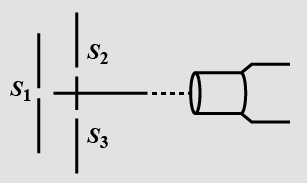
A student is asked to measure the wavelength of monochromatic light. He sets up the apparatus as shown. $S_1​,S_2​,S_{3​}$ are narrow parallel slits. $L$ is radiant lamps and $M$ is a micrometer eyepiece. The student fails to observe interference fringes. We would advice him to:
A conducting rod is moved with a constant velocity v in a magnetic field. A potential difference appears across the two ends: