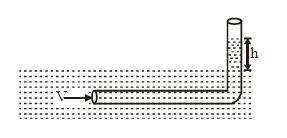
An $L-$ shaped glass tube is just immersed in flowing water towards tube as shown. If speed of water current is $V,$ then the height $h$ upto which water rises will be
Medium


Download our appand get started for free
Experience the future of education. Simply download our apps or reach out to us for more information. Let's shape the future of learning together!No signup needed.*
Similar Questions
- 1A barometer kept in a stationary elevator reads $76 cm$. If the elevator starts accelerating up the reading will beView Solution
- 2A hemispherical bowl just floats without sinking in a liquid of density $1.2 × 10^3kg/m^3$. If outer diameter and the density of the bowl are $1 m$ and $2 × 10^4 kg/m^3$ respectively, then the inner diameter of the bowl will be........ $m$View Solution
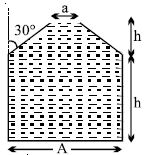
- 3The vessel shown in the figure has two sections. The lower part is a rectangular vessel with area of cross-section $A$ and height $h$. The upper part is a conical vessel of height $h$ with base area $‘A’$ and top area $‘a’$ and the walls of the vessel are inclined at an angle $30^o$ with the vertical.A liquid of density $\rho$ fills both the sections upto a height $2h$. Neglecting atmospheric pressure.View Solution
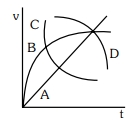
- 4A spherical ball is dropped in a long column of a highly viscous liquid. The curve in the graph shown, which represents the speed of the ball $(v)$ as a function of time $(t)$ isView Solution
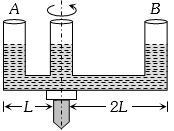
- 5A given shaped glass tube having uniform cross section is filled with water and is mounted on a rotatable shaft as shown in figure. If the tube is rotated with a constant angular velocity $\omega $thenView Solution
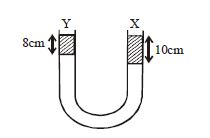
- 6An object with uniform density $\rho$ is attached to a spring that is known to stretch linearly with applied force as shown below.When the spring object system is immersed in a liquid of density $\rho_1$ as shown in the above figure, the spring stretches by an amount $x_1\left(\rho > \rho_1\right)$. When the experiment is repeated in a liquid of density $\left(\rho_2 < \rho_1\right)$, the spring stretches by an amount $x_2$. Neglecting any buoyant force on the spring, the density of the object isView Solution
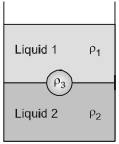
- 7A jar is filled with two non-mixing liquids $1$ and $2$ having densities $\rho_1$ and, $\rho_2$ respectively. A solid ball, made of a material of density $\rho_3$ , is dropped in the jar. It comes to equilibrium in the position shown in the figure.Which of the following is true for $\rho_1 , \rho_2$ and $\rho_3$?View Solution
- 8View SolutionThe displacement of a ball falling from rest in a viscous medium is platted against time. Choose a possible option
- 9A thin uniform tube is bent into a circle of radius $r$ in the virtical plane. Equal volumes of two immiscible liquids, whose densities are ${\rho _1}$ and ${\rho _2}\left( {{\rho _1} > {\rho _2}} \right)$ fill half the circle. The angle $\theta$ between the radius vector passing through the common interface and the vertical isView Solution
- 10A liquid $X$ of density $3.36\ g/cm^3$ is poured in a $U-$ tube, which contains $Hg$. Another liquid $Y$ is poured in left arm with height $8\ cm$, upper levels of $X$ and $Y$ are same. What is density of $Y$ .......... $g/cc$View Solution