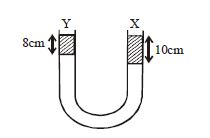
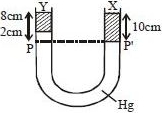
A liquid $X$ of density $3.36\ g/cm^3$ is poured in a $U-$ tube, which contains $Hg$. Another liquid $Y$ is poured in left arm with height $8\ cm$, upper levels of $X$ and $Y$ are same. What is density of $Y$ .......... $g/cc$
Medium


Download our appand get started for free
Experience the future of education. Simply download our apps or reach out to us for more information. Let's shape the future of learning together!No signup needed.*
Similar Questions
- 1A small sphere of radius $r$ falls from rest in a viscous liquid. As a result, heat is produced due to viscous force. The rate of production of heat when the sphere attains its terminal velocity, is proportional toView Solution
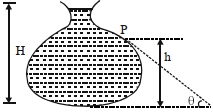
- 2Figure here shows the vertical cross section of a vessel filled with a liquid of density $\rho$. The normal thrust per unit area on the walls of the vessel at the point $P$, as shown, will beView Solution
- 3A liquid is kept in a cylindrical vessel which is being rotated about a vertical axis through the centre of the circular base. If the radius of the vessel is $ r $ and angular velocity of rotation is $\omega $, then the difference in the heights of the liquid at the centre of the vessel and the edge isView Solution
- 4A piece of copper having an internal cavity weights $264\, g$ in air and $221\, g$ in water. Find volume (in $cc$) of cavity. Density of $Cu = 8.8\, g/cc$View Solution
- 5A cube of edge length $10 \,cm$ is just balanced at the interface of two liquids $A$ and $B$ as shown in figure. If $A$ and $B$ has specific gravity $0.6$ and $0.4$ respectively, then mass of cube is ................ $g$View Solution

- 6A liquid drop of mass $m$ and radius $r$ is falling from great height. Its velocity is proportional to ............View Solution
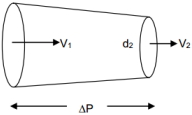
- 7Determine the pressure difference in tube of non$-$uniform cross sectional area as shown in figure. $\Delta P =?$ (in $pa$)View Solution
$d_{1}=5\, cm , V_{1}=4\, cm , d_{2}=2\, cm , V_{2}=?$
- 8Two solids $A$ and $ B$ float in water. It is observed that $A$ floats with $\frac{1}{2}$ of its body immersed in water and $ B$ floats with $\frac{1}{4}$ of its volume above the water level. The ratio of the density of $ A$ to that of $B$ isView Solution
- 9Eight equal drops of water are falling through air with a steady speed of $10\,cm / s$. If the drops coalesce, the new velocity is $.........\,cm/s$View Solution
- 10Three capillaries of length $L, \frac{L}{2}$ and $\frac{L}{3}$ are connected in series. Their radii are $r, \frac{r}{2}$ and $\frac{r}{3}$ respectively. Then if stream-line flow is to be maintained and the pressure across the first capillary is $P$, then ............View Solution