An $LCR$ circuit is equivalent to a damped pendulum. In an $LCR$ circuit the capacitor is charged to $Q_0$ and then connected to the $L$ and $R$ as shown below.
If a student plots graphs of the square of maximum charge $( Q_{Max} ^2 )$ on the capacitor with time$(t)$ for two different values $L_1$ and $L_2 (L_1 > L_2)$ of $L$ then which of the following represents this graph correctly? (plots are schematic and not drawn to scale)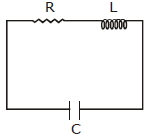
JEE MAIN 2015, Diffcult
Download our app for free and get started
From $KVL$ at any time :
$\frac{q}{c}-i R-I \cdot \frac{d i}{d t}=0$
$\mathrm{i}=-\frac{\mathrm{d} q}{\mathrm{dt}} \Rightarrow \frac{\mathrm{q}}{\mathrm{c}}+\frac{\mathrm{dq}}{\mathrm{dt}} \mathrm{R}+\frac{\mathrm{Ld}^{2} \mathrm{q}}{\mathrm{dt}^{2}}=0$
$\frac{d^{2} q}{d t^{2}}+\frac{R}{I} \frac{d q}{d t}+\frac{q}{I c}=0$
From damped harmonic oscillator, the amplitude is given by $\mathrm{A}=\mathrm{A}_{0} \mathrm{e}-\frac{\mathrm{dt}}{2 \mathrm{m}}$
Double differential equation $\frac{\mathrm{d}^{2} \mathrm{x}}{\mathrm{dt}^{2}}+\frac{\mathrm{b}}{\mathrm{m}} \frac{\mathrm{dx}}{\mathrm{dt}}+\frac{\mathrm{k}}{\mathrm{m}} \mathrm{x}=0$
$\mathrm{Q}_{\max }=\mathrm{Q}_{\mathrm{o}} \mathrm{e}-\frac{\mathrm{Rt}}{2 \mathrm{L}} \Rightarrow \mathrm{Q}_{\max }^{2}=\mathrm{Q}_{\mathrm{o}}^{2} \mathrm{e}-\frac{\mathrm{Rt}}{\mathrm{L}}$
Hence damping will be faster for lesser self inductance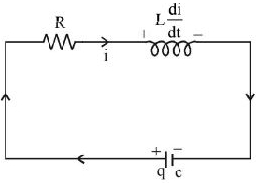

Download our appand get started for free
Experience the future of education. Simply download our apps or reach out to us for more information. Let's shape the future of learning together!No signup needed.*
Similar Questions
- 1A mass $M$ is suspended from a light spring. An additional mass m added displaces the spring further by a distance $x$. Now the combined mass will oscillate on the spring with periodView Solution
- 2The displacement of a particle is given at time $t$, by:$x=A \sin (-2 \omega t)+B \sin ^2 \omega t \quad$ Then,View Solution
- 3View SolutionTwo mutually perpendicular simple harmonic vibrations have same amplitude, frequency and phase. When they superimpose, the resultant form of vibration will be
- 4A weightless spring which has a force constant oscillates with frequency $n$ when a mass $m$ is suspended from it. The spring is cut into two equal halves and a mass $2m $ is suspended from it. The frequency of oscillation will now becomeView Solution
- 5A particle executes $S.H.M.$ with amplitude $'a'$ and time period $V$. The displacement of the particle when its speed is half of maximum speed is $\frac{\sqrt{ x } a }{2} .$ The value of $x$ is $\ldots \ldots \ldots$View Solution
- 6The potential energy of a particle $\left(U_x\right)$ executing $S.H.M$. is given byView Solution
- 7View SolutionIn case of a simple pendulum, time period versus length is depicted by
- 8Two particles are executing S.H.M. The equation of their motion are ${y_1} = 10\sin \left( {\omega \,t + \frac{{\pi T}}{4}} \right),$ ${y_2} = 25\sin \,\left( {\omega \,t + \frac{{\sqrt 3 \pi T}}{4}} \right)$. What is the ratio of their amplitudeView Solution
- 9The potential energy of a simple harmonic oscillator at mean position is $2\,joules$. If its mean $K.E.$ is $4\,joules$, its total energy will be .... $J$View Solution
- 10For a simple pendulum the graph between $L$ and $T$ will be.View Solution