Question
An object falling through a fluid is observed to have acceleration given by $a = g -bv$ where $g =$ gravitational acceleration and $b$ is constant. After a long time of release, it is observed to fall with constant speed. The value of constant speed is
Answer

Here, $a=g-b v$

When an object falls with constant speed $v_{c},$ its

acceleration becomes zero.

$\mathrm{g}-\mathrm{bv}_{\mathrm{c}}=0 \text { or } \mathrm{v}_{\mathrm{c}}=\frac{\mathrm{g}}{\mathrm{b}}$

Need a full question paper?

Generate a complete, print-ready paper with questions like this in minutes — across 16+ boards, with answer keys.

Start Generating Free

Similar questions

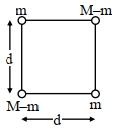
A body of mass ($2 {M}$) splits into four masses $\{{m}, {M}-{m}, {m}, {M}-{m}\}$, which are rearranged to form a square as shown in the figure. The ratio of $\frac{{M}}{{m}}$ for which, the gravitational potential energy of the system becomes maximum is ${x}: 1$. The value of $x$ is ..... .
A stone of mass $m$ is tied to a string of length $l$ and rotated in a circle with a constant speed $v$. If the string is released, the stone flies
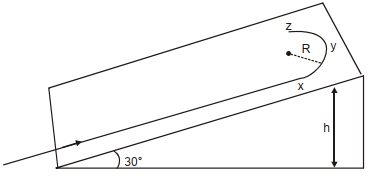
A student skates up a ramp that makes an angle $30^{\circ}$ with the horizontal. $He /$ she starts (as shown in the figure) at the bottom of the ramp with speed $v_0$ and wants to turn around over a semicircular path xyz of radius $R$ during which he/she reaches a maximum height $h$ (at point y) from the ground as shown in the figure. Assume that the energy loss is negligible and the force required for this turn at the highest point is provided by his/her weight only. Then ( $g$ is the acceleration due to gravity)

$(A)$ $v_0^2-2 g h=\frac{1}{2} g R$

$(B)$ $v_0^2-2 g h=\frac{\sqrt{3}}{2} g R$

$(C)$ the centripetal force required at points $x$ and $z$ is zero

$(D)$ the centripetal force required is maximum at points $x$ and $z$

Time taken by the sunlight to pass through a window of thickness $4\, mm$ whose refractive index is $1.5$ is
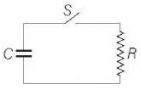
The capacitor of capacitance $C$ in the circuit shown is fully charged initially resistance is $R$. After the switch $S$ is closed, the time taken to reduce the stored energy in the capacitor to half its initial value is
On increasing number density for a gas in a vessel, mean free path of a gas
The specific heat capacity of a metal at low temperature $(T)$ is given as $C_p=32\left(\frac{ T }{400}\right)^{3}\;kJ\,k ^{-1}\, kg ^{-1}$. A $100\; g$ vessel of this metal is to be cooled from $20 \;K$ to $4\; K$ by a special refrigerator operating at room temperature $27^\circ c$). The amount of work required to cool the vessel is
At constant volume, for different diatomic gases the molar specific heat is
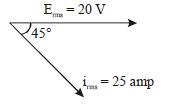
The vector diagram of current and voltage for a circuit is as shown. The components of the circuit will be
Energy required for the electron excitation in $Li^{++}$ from the first to the third Bohr orbit is.....$eV$