Question
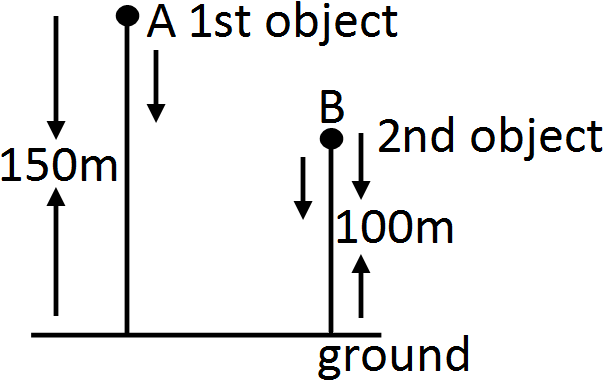
An object is dropped from rest at a height of $150m$ and simultaneously another object is dropped from rest at a height $100m.$ What is the difference in their heights after $2s$ if both the objects drop with same accelerations? How does the difference in heights vary with time?
Answer

For first object given, $u = 0 ($because object dropped from rest$)$ and time$ (t) = 2s$ from second equation of motion, the distance covered by first object in $2s$ is$\text{h}=\text{ut}+\frac{1}{2}\text{gt}^2$
$\text{h}=0\times2+\frac{1}{2}\times10\times(2)^2\ [\because\text{g}=10\text{m/ s}^{2}]$
$\text{h}=0+\frac{1}{2}\times10\times4=20\text{m}$

Height of first object from the ground after $2s (h_1) = 150m - 20m = 130m$ for second object guven, $u = 0$ and time $(t) = 2s$ From second equation of motion, the distance covered by second object in $2s$ is $\text{h}=\text{ut}+\frac{1}{2}\text{gt}^2=0\times2+\frac{1}{2}\times10\times(2)^2\ [\because\text{g}=10\text{m/ s}^2]$
$=0+\frac{1}{2}\times1=\times4=20\text{m}$
Height of second object from the ground after $2s$ then $h_2 = 100m – 20m = 80m$
Now, difference in the height after $2s = h_1 – h_2 = 130 – 80 = 50 m$
The difference in hights of the objects will remain same with time as both the objects have been dropped from rest and are falling with same acceleration i.e $($acceleration due to gravity$).$

Need a full question paper?

Generate a complete, print-ready paper with questions like this in minutes — across 16+ boards, with answer keys.

Start Generating Free