MCQ
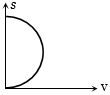
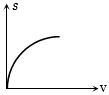
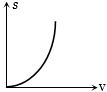
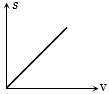
An object is moving with a uniform acceleration which is parallel to its instantaneous direction of motion. The displacement $(s) - $ velocity $(v)$ graph of this object is
  • A

  • B


  • D

Answer

Correct option: C.

c
(c) ${v^2} = {u^2} + 2aS$, If $u = 0$ then ${v^2} \propto S$

i.e. graph should be parabola symmetric to displacement axis.

Need a full question paper?

Generate a complete, print-ready paper with questions like this in minutes — across 16+ boards, with answer keys.

Start Generating Free

Similar questions

A ball strikes against the floor and returns with double the velocity; in which type of collision is it possible?
Which of the following velocity-time graphs is physically not possible?
Two pieces of glass plate one upon the other with a little water in between them cannot be separated easily because of
The scale on a steel meter rod is calibrated at 20°C. What will be the error in the reading of 50cm at 27°C? Take, $\alpha=1.2\times10^{-5}\ ^\circ\text{C}^{-1}.$
A block of mass m is placed on a smooth inclined plane of inclination $\theta$ with the horizontal. The force exerted by the plane on the block has a magnitude:
A Carnot engine with sink's temperature at $17\,^oC$ has $50\%$ efficiency. By how much should its source temperature be changed to increases its efficiency to $60\%$ ?...... $K$
A ball suspended by a thread swings in a vertical plane so that its magnitude of acceleration in the extreme position and lowest position are equal. The angle $(\theta)$ of thread deflection in the extreme position will be :
Given below are two statements: One is labelled as Assertion $(A)$ and other is labelled as Reason $(R)$.

Assertion $(A)$ : Time period of oscillation of a liquid drop depends on surface tension $(S)$, if density of the liquid is $p$ and radius of the drop is $r$, then $T = k \sqrt{ pr ^{3} / s ^{3 / 2}}$ is dimensionally correct, where $K$ is dimensionless.

Reason $(R)$: Using dimensional analysis we get $R.H.S.$ having different dimension than that of time period.

In the light of above statements, choose the correct answer from the options given below.

A body at rest may have
Heat is flowing through a conductor of length l from $x = 0$ to $x = l$ . If its thermal resistance per unit length is uniform, which of the following graphs is correct