Question
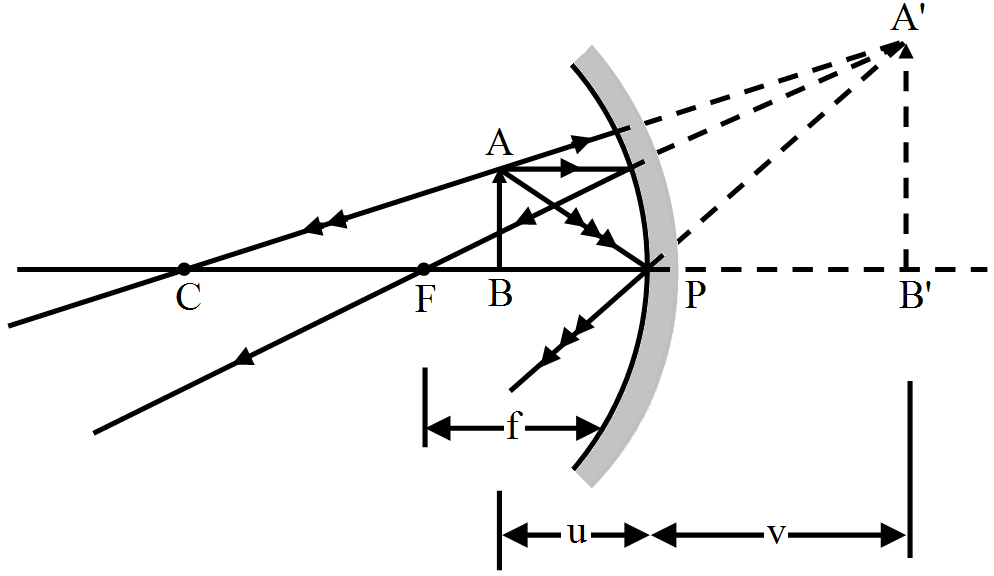
  1. An object is placed in front of a concave mirror. It is observed that a virtual image is formed. Draw the ray diagram to show the image formation and hence derive the mirror equation $\frac{1}{\text{f}}=\frac{1}{\text{u}}+\frac{1}{\text{v}}.$
  2. An object is placed 30cm in front of a plano-convex lens with its spherical surface of radius of curvature 20cm. If the refractive index of the material of the lens is 1.5, find the position and nature of the image formed.

Answer

  1.  

$\triangle\text{ABC}\sim\triangle\text{A}_1\text{B}_1\text{C}$

$\Rightarrow\frac{\text{A}_1\text{B}_1}{\text{AB}}=\frac{\text{A}_1\text{C}}{\text{AC}}=\frac{(+\text{v})+(-\text{R)}}{(-\text{R})-(-\text{u)}}\ ...(1)$

$\triangle\text{ABP}\sim\triangle\text{A}_1\text{B}_1\text{P}$

$\Rightarrow\frac{\text{A}_1\text{B}_1}{\text{AB}}=\frac{\text{A}_1\text{P}}{\text{AP}}=\frac{+\text{v}}{-\text{u}}\ ...(2)$

$(1)=(2)$

$\Rightarrow\frac{\text{v}-\text{R}}{-\text{R}+\text{u}}=\frac{\text{v}}{-\text{u}}$

$\Rightarrow-\text{uv}+\text{uR}=-\text{vR}+\text{uv}$

$\Rightarrow\text{uR}+\text{vR}=2\text{uv}$

$\div\text{ by }\text{uvR}$

$\Rightarrow\frac{1}{\text{v}}+\frac{1}{\text{u}}=\frac{2}{\text{R}}$

$\because\text{R}=2\text{F}$

$\therefore\frac{1}{\text{v}}+\frac{1}{\text{u}}=\frac{1}{\text{f}}$

  1. $\frac{1}{\text{f}}=(1.5-1)\Big(\frac{1}{20}-\frac{1}{\infty}\Big)$

$=\frac{0.5}{20}=\frac{5}{200}=\frac{1}{40}$

$\therefore\text{f}=40\text{cm}$

Now, $\frac{1}{\text{f}}=\frac{1}{\text{v}}-\frac{1}{\text{v}}$

$\Rightarrow\text{v}=\frac{\text{fu}}{\text{f}+\text{u}}=\frac{40\times-30}{40-30}$

$\Rightarrow\text{v}=\frac{-40\times30}{10}=-120\text{cm}$

Image is virtual, erect and enlarged in front of lens 120cm away.
Need a full question paper?

Generate a complete, print-ready paper with questions like this in minutes — across 16+ boards, with answer keys.

Start Generating Free

Similar questions

What is meant by electric field intensity? Write its units and dimensional formula. Find the expression for the electric field intensity at a point due to a point charge. Draw a graph between electric field intensity E and distance r.
Establish the relation between electric field and potential gradient.
When a dielectric is placed in an electric field, it gets polarized. The electric field in a polarized material is less than the applied field. When a paramagnetic substance is kept in a magnetic field, the field in the substance is more than the applied field. Explain the reason of this opposite behaviour.
The electric field associated with a light wave is given by $\text{E}=\text{E}_0\sin[(1.57\times10^7\text{m}^{-1})(\text{x}-{\text{ct}})].$ Find the stopping potential when this light is used in an experiment on photoelectric effect with the emitter having work function 1.9eV.
When a proton is released from rest in a room, it starts with an initial acceleration a0 towards west. When it is projected towards north with a speed v0, it moves with an initial acceleration 3a0 towards west. Find the electric field and the maximum possible magnetic field in the room.
Steam at 120°C is continuously passed through a 50cm long rubber tube of inner and outer radii 1.0cm and 1.2cm. The room temperature is 30°C. Calculate the rate of heat flow through the walls of the tube. Thermal conductivity of rubber = 0.15Js-1m-1°C-1.
Figure shows a man of mass 60kg standing on a light weighing machine kept in a box of mass 30kg. The box is hanging from a pulley fixed to the ceiling through a light rope, the other end of which is held by the man himself. If the man manages to keep the box at rest, what is the weight shown by the machine? What force should he exert on the rope to get his correct weight on the machine?

The force exerted by the floor of an elevator on the foot of a person standing there is more than the weight of the person if the elevator is:
  1. Going up and slowing down.
  2. Going up and speeding up.
  3. Going down and slowing down.
  4. Going down and speeding up.
The two square faces of a rectangular dielectric slab (dielectric constant 4.0) of dimensions 20cm × 20cm × 1.0mm are metal-coated. Find the capacitance between the coated surfaces.