An object of height 4cm is placed at a distance of 15cm in front of a concave lens of power, -10 dioptres. Find the size of the image.
Download our app for free and get started
h = 4cm u = -15cm P = -10D$\text{P}=\frac{1}{\text{f}}$
$\text{f}=\frac{1}{\text{P}}$
$=\frac{1}{-10}$
$=-0.1\text{m}$
$=-10\text{cm}$
Using Lens formula,$\frac{1}{\text{f}}=\frac{1}{\text{v}}-\frac{1}{\text{u}}$
$\frac{1}{\text{v}}=\frac{1}{\text{f}}+\frac{1}{\text{u}}$
$=\frac{1}{-10}+\frac{1}{-15}$
$=\frac{-5}{30}$
$\text{v}=-6\text{cm}$
Magnification, $\text{m}=\frac{\text{h}'}{\text{h}}=\frac{\text{v}}{\text{u}}$$\frac{\text{h}'}{4}=\frac{-6}{-15}$
$\text{h}'=1.6\text{cm}$
$\text{f}=\frac{1}{\text{P}}$
$=\frac{1}{-10}$
$=-0.1\text{m}$
$=-10\text{cm}$
Using Lens formula,$\frac{1}{\text{f}}=\frac{1}{\text{v}}-\frac{1}{\text{u}}$
$\frac{1}{\text{v}}=\frac{1}{\text{f}}+\frac{1}{\text{u}}$
$=\frac{1}{-10}+\frac{1}{-15}$
$=\frac{-5}{30}$
$\text{v}=-6\text{cm}$
Magnification, $\text{m}=\frac{\text{h}'}{\text{h}}=\frac{\text{v}}{\text{u}}$$\frac{\text{h}'}{4}=\frac{-6}{-15}$
$\text{h}'=1.6\text{cm}$

Download our appand get started for free
Experience the future of education. Simply download our apps or reach out to us for more information. Let's shape the future of learning together!No signup needed.*
Similar Questions
- 1View SolutionAn object is placed at a distance of 4cm from a concave lens of focal length 12cm. Find the position and nature of the image.
- 2View SolutionTwo lenses A and B have focal lengths of +20cm and, -10cm, respectively.
- What is the nature of lens A and lens B?
- What is the power of lens A and lens B?
- What is the power of combination if lenses A and B are held close together?
- 3View SolutionThe two rays chosen for the construction of ray diagram is:
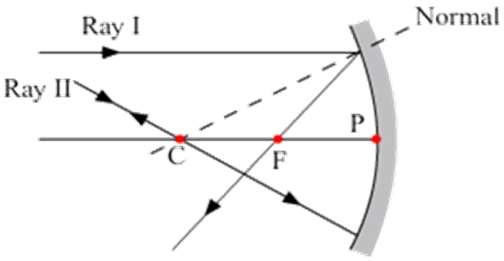
Ray 1: When the incident ray is parallel to the principal axis, the reflected ray will pass through the focus of concave mirror or it appears to pass through the focus of convex mirror.
Ray 2: When the incident ray passes through or appears to pass through the centre of curvature, the light, after reflection from the spherical mirror, reflects back along the same path.
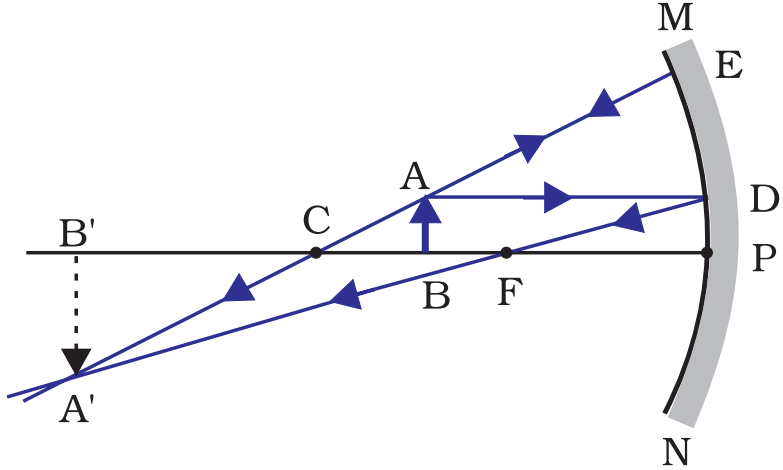
The image formed is real, inverted, magnified and is formed beyond the centre of curvature.
- 4View SolutionA lens of focal length 20cm is used to produce a ten times magnified image of a film slide on a screen. How far must the slide be placed from the lens ?
- 5View SolutionTwo lenses have powers of (i) +2D and (ii) -4D. What is the nature and focal length of each lens?
- 6View SolutionAn object 5.0 cm in length is placed at a distance of 20 cm in front of a convex mirror of radius of curvature 30 cm. Find the position of the image, its nature and size.
- 7An image $\frac{2}{3}\text{rd}$ the size of object is formed by a convex lens at a distance of 12cm from Find the focal length of the lens.View Solution
- 8View SolutionA concave lens has focal length 15cm. At what distance should the object from the lens be placed so that it forms an image at 10cm from the lens? Also find the magnification produced by the lens.
- 9View SolutionAn object placed on a metre scale at 8 cm mark was focussed on a white screen placed at 92 cm mark, using a converging lens placed on the scale at 50 cm mark.
- Find the focal length of the converging lens.
- Find the position of the image formed if the object is shifted towards the lens at a position of 29.0 cm.
- State the nature of the image formed if the object is further shifted towards the lens.
- 10View SolutionGive two circumstances in which a concave mirror can form a magnified image of an object placed in
front of it. Illustrate your answer by drawing labelled ray diagrams for both.