Two lenses have powers of (i) +2D and (ii) -4D. What is the nature and focal length of each lens?
Download our app for free and get started
- Given that,
Using the the formula,
We get,
$\frac{1}{\text{f}}=2$
${\text{f}}=\frac{1}{2}$
${\text{f}}=0.5\text{m}$
$\text{f}=50\text{cm}$
The lens is convex lens of focal length = 0.5m = 50cm
- Given that,
Using the the formula,
We get,
$\frac{1}{\text{f}}=-4$
${\text{f}}=\frac{1}{-4}$
${\text{f}}=-0.25\text{m}$
$\text{f}=-25\text{cm}$
The lens is concave lens of focal length = -0.25m = -25cm

Download our appand get started for free
Experience the future of education. Simply download our apps or reach out to us for more information. Let's shape the future of learning together!No signup needed.*
Similar Questions
- 1View SolutionAn object of height 4.25mm is placed at a distance of 10cm from a convex lens of power +5D. Find:
- Focal length of the lens, and
- Size of the image.
- 2View SolutionUnder what condition in an arrangement of two plane mirrors, incident ray and reflected ray will always be parallel to each other, whatever may be angle of incidence. Show the same with the help of diagram.
- 3View SolutionGiving reasons, state the ‘signs’ (positive or negative) which can be given to the following:
- Object distance (u) for a concave mirror or convex mirror.
- Image distances (v) for a concave mirror.
- Image distances (v) for a convex mirror.
- 4View SolutionWhat is meant by the ‘angle of incidence’ and the ‘angle of refraction’ for a ray of light? Draw a labelled ray diagram to show the angle of incidence and the angle of refraction for a refracted ray of light.
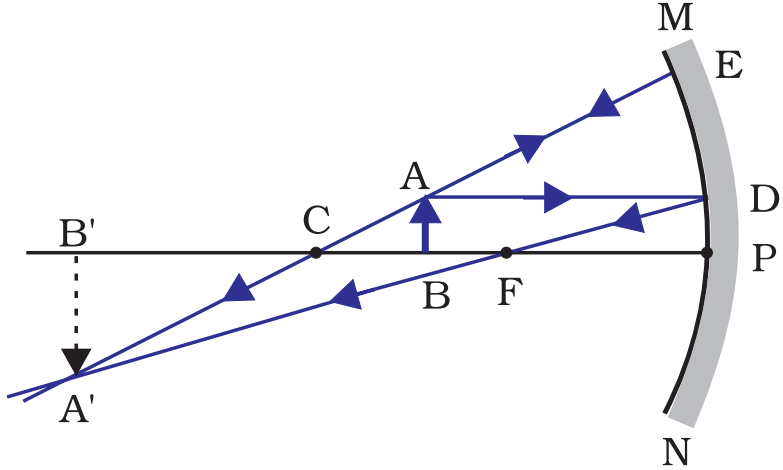
- 5View SolutionThe two rays chosen for the construction of ray diagram is:
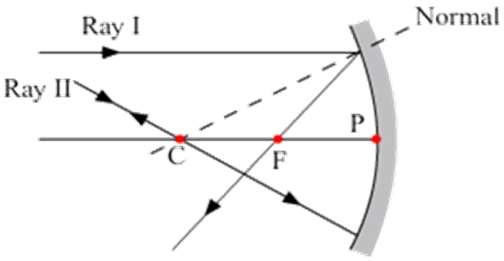
Ray 1: When the incident ray is parallel to the principal axis, the reflected ray will pass through the focus of concave mirror or it appears to pass through the focus of convex mirror.
Ray 2: When the incident ray passes through or appears to pass through the centre of curvature, the light, after reflection from the spherical mirror, reflects back along the same path.
The image formed is real, inverted, magnified and is formed beyond the centre of curvature.
- 6View SolutionAt what distance should an object be placed from a convex lens of focal length 18cm to obtain an image at 24cm from it on the other side? What will be the magnification produced in this case?
- 7View SolutionA concave lens has focal length 15cm. At what distance should the object from the lens be placed so that it forms an image at 10cm from the lens? Also find the magnification produced by the lens.
- 8View SolutionAn object 2cm tall is placed on the axis of a convex lens of focal length 5cm at a distance of 10m from the optical centre of the lens. Find the nature, position and size of the image formed. Which case of image formation by convex lenses is illustrated by this example?
- 9View Solution(i) Explain why the refractive index of any material with respect to air is always greater 1 .
(ii) In the figure below a light ray travels from air into the semi-circular plastic block. Give a reason why the ray does not deviate at the semi-circular boundary of the plastic block.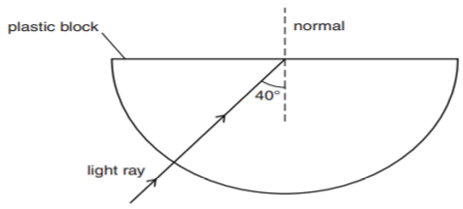
(iii) Complete the ray diagram of the above scenario when the light ray comes out of the plastic block from the top flat end. - 10View SolutionHow are power and focal length of a lens related? You are provided with two lenses of focal length 20cm and 40cm respectively. Which lens will you use to obtain more convergent light?