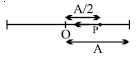
An object of mass $0.2\, kg$ executes simple harmonic along $X-$ axis with frequency of $\frac{{25}}{\pi }Hz$. At the position $x = 0.04m$, the object has kinetic energy of $0.5 \,J$ and potential energy of $0.4\, J$ amplitude of oscillation in meter is equal to
Medium
Download our app for free and get started
(b) $E = \frac{1}{2}m{\omega ^2}{A^2}$$ \Rightarrow $$E = \frac{1}{2}m\,{(2\pi f)^2}{A^2}$$ \Rightarrow $$A = \frac{1}{{2\pi f}}\sqrt {\frac{{2E}}{m}} $
Putting $E = K + U$ we obtain,
$A = \frac{1}{{2\pi \left( {\frac{{25}}{\pi }} \right)}}\sqrt {\frac{{2 \times (0.5 + 0.4)}}{{0.2}}} $ $ \Rightarrow A = 0.06\,m$

Download our appand get started for free
Experience the future of education. Simply download our apps or reach out to us for more information. Let's shape the future of learning together!No signup needed.*
Similar Questions
- 1A particle is executing a simple harmonic motion. Its maximum acceleration is $\alpha$ and maximum velocity is $\beta$. Then, its time period of vibration will beView Solution
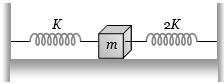
- 2Two springs of force constants $K$ and $2K$ are connected to a mass as shown below. The frequency of oscillation of the mass isView Solution
- 3One end of a long metallic wire of length $L$ is tied to the ceiling. The other end is tied to massless spring of spring constant $K$. A mass $ m$ hangs freely from the free end of the spring. The area of cross-section and Young's modulus of the wire are $A$ and $Y$ respectively. If the mass is slightly pulled down and released, it will oscillate with a time period $T$ equal toView Solution
- 4View SolutionTwo mutually perpendicular simple harmonic vibrations have same amplitude, frequency and phase. When they superimpose, the resultant form of vibration will be
- 5Time period of a simple pendulum is $T$. The time taken to complete $5 / 8$ oscillations starting from mean position is $\frac{\alpha}{\beta} T$. The value of $\alpha$ is ..... .View Solution
- 6A particle performs simple harmonic motion with amplitude A. Its speed is increased to three times at an instant when its displacement is $\frac{2 \mathrm{~A}}{3}$. The new amplitude of motion is $\frac{\mathrm{nA}}{3}$. The value of $\mathrm{n}$ is____.View Solution
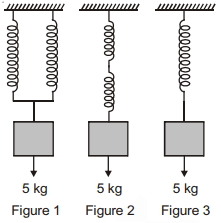
- 7Two identical springs have the same force constant $73.5 \,Nm ^{-1}$. The elongation produced in each spring in three cases shown in Figure-$1$, Figure-$2$ and Figure-$3$ are $\left(g=9.8 \,ms ^{-2}\right)$View Solution
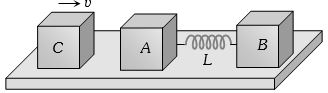
- 8Two blocks $A$ and $B$ each of mass m are connected by a massless spring of natural length L and spring constant $K$. The blocks are initially resting on a smooth horizontal floor with the spring at its natural length as shown in figure. A third identical block $C$ also of mass $m$ moves on the floor with a speed $v$ along the line joining $A$ and $B$ and collides with $A$. ThenView Solution
- 9The length of the second pendulum on the surface of earth is $1\, m$. The length of seconds pendulum on the surface of moon, where g is 1/6th value of $g$ on the surface of earth, isView Solution
- 10A particle starts from a point $P$ at a distance of $A/2$ from the mean position $O\, \&$ travels towards left as shown in the figure. If the time period of $SHM,$ executed about $O$ is $T$ and amplitude $A$ then the equation of motion of particle is :View Solution