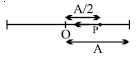
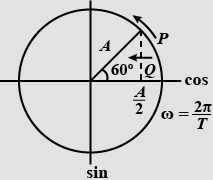
A particle starts from a point $P$ at a distance of $A/2$ from the mean position $O\, \&$ travels towards left as shown in the figure. If the time period of $SHM,$ executed about $O$ is $T$ and amplitude $A$ then the equation of motion of particle is :
Advanced


Download our appand get started for free
Experience the future of education. Simply download our apps or reach out to us for more information. Let's shape the future of learning together!No signup needed.*
Similar Questions
- 1The piston in the cylinder head of locomotive has a stroke of $6\,m$ (which is twice the amplitude). If the piston executing simple harmonic motion with an angular frequency of $200\, rad\, min^{-1}$, its maximum speed is .... $ms^{-1}$View Solution
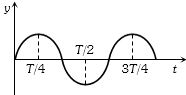
- 2View SolutionThe graph shows the variation of displacement of a particle executing S.H.M. with time. We infer from this graph that
- 3A particle executes $S.H.M.$ of amplitude A along $x$-axis. At $t =0$, the position of the particle is $x=\frac{A}{2}$ and it moves along positive $x$-axis the displacement of particle in time $t$ is $x=A \sin (\omega t+\delta)$, then the value $\delta$ will beView Solution
- 4$Assertion :$ In simple harmonic motion, the motion is to and fro and periodicView Solution
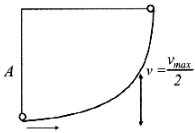
$Reason :$ Velocity of the particle $(v) = \omega \sqrt {k^2 - x^2}$ (where $x$ is the displacement). - 5A particle starts with $S.H.M.$ from the mean position as shown in the figure. Its amplitude is $A$ and its time period is $T$. At one time, its speed is half that of the maximum speed. What is this displacement?View Solution
- 6The length of a seconds pendulum at a height $h=2 R$ from earth surface will be.(Given: $R =$ Radius of earth and acceleration due to gravity at the surface of earth $g =\pi^{2}\,m / s ^{-2}$ )View Solution
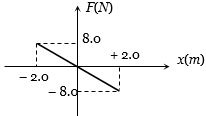
- 7A body of mass $0.01 kg$ executes simple harmonic motion $(S.H.M.)$ about $x = 0$ under the influence of a force shown below : The period of the $S.H.M.$ is .... $s$View Solution
- 8A body of mass $5\, gm$ is executing $S.H.M.$ about a point with amplitude $10 \,cm$. Its maximum velocity is $100\, cm/sec$. Its velocity will be $50\, cm/sec$ at a distanceView Solution
- 9A rectangular block of mass $5\,kg$ attached to a horizontal spiral spring executes simple harmonic motion of amplitude $1\,m$ and time period $3.14\,s$. The maximum force exerted by spring on block is $.......N$.View Solution
- 10For a periodic motion represented by the equation $Y=\sin \omega t+\cos \omega t$ The amplitude of the motion isView Solution