An object of mass $1 \,kg$ moving on a horizontal surface with initial velocity $8 \,m / s$ comes to rest after $10 \,s$. If one wants to keep the object moving on the same surface with velocity $8 \,m / s$ the force required is ...... $N$
Easy


Download our appand get started for free
Experience the future of education. Simply download our apps or reach out to us for more information. Let's shape the future of learning together!No signup needed.*
Similar Questions
- 1The normal reaction $'{N}^{\prime}$ for a vehicle of $800\, {kg}$ mass, negotiating a turn on a $30^{\circ}$ banked road at maximum possible speed without skidding is $...\,\times 10^{3}\, {kg} {m} / {s}^{2}$ [Given $\left.\cos 30^{\circ}=0.87, \mu_{{s}}=0.2\right]$View Solution
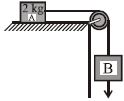
- 2The coefficient of static friction, $\mu _s$ between block $A$ of mass $2\,kg$ and the table as shown in the figure is $0.2$. What would be the maximum mass value of block $B$ so that the two blocks $B$ so that the two blocks do not move? The string and the pulley are assumed to be smooth and masseless ....... $kg$ $(g = 10\,m/s^2)$View Solution
- 3A cyclist riding the bicycle at a speed of $14 \sqrt{3} \,m / s$ takes a turn around a circular road of radius $20 \sqrt{3} \,m$ without skidding. What is his inclination to the vertical?View Solution
- 4A block of $1\, kg$ is stopped against a wall by applying a force $F$ perpendicular to the wall. If $\mu = 0.2$ then minimum value of $F$ will be ....... $N.$View Solution
- 5Calculate the maximum acceleration (in $m s ^{-2}$) of a moving car so that a body lying on the floor of the car remains stationary. The coefficient of static friction between the body and the floor is $0.15$ $\left( g =10 m s ^{-2}\right)$.View Solution
- 6$Assertion$ : There is a stage when frictional force is not needed at all to provide the necessary centripetal force on a banked road.View Solution
$Reason$ : On a banked road, due to its inclination the vehicle tends to remain inwards without any chances of skidding. - 7A railway line is taken round a circular arc of radius $1000\ m$ , and is banked by raising the outer rail $h$ $m$ above the inner rail. If the lateral force on the inner rail when a train travels round the curve at $10\ ms^{-1}$ is equal to the lateral force on the outer rail when the train's speed is $20\ ms^{-1}$ . The value of $4g\ tan\theta $ is equal to : (The distance between the rails is $1.5\ m$ )View Solution
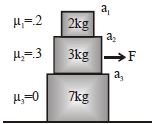
- 8Find the acceleration of $a_1, a_2$ and $a_3$. If $10\,N$ force $F$ is applied on $3\,kg$ block :-View Solution
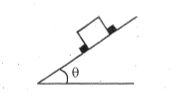
- 9View SolutionA box is placed on an inclined plane and has to be pushed down. The angle of inclination is
- 10A car is moving with a constant speed of $20\,m / s$ in a circular horizontal track of radius $40\,m$. A bob is suspended from the roof of the car by a massless string. The angle made by the string with the vertical will be : (Take $g =10$ $\left.m / s ^2\right)$View Solution