MCQ
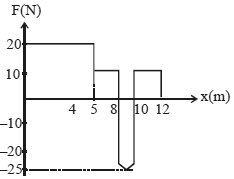
An object of mass $500\; \mathrm{g}$, intitally at rest acted upon by a variable force where $\mathrm{X}$ component varies with $\mathrm{X}$ in the manner shown. The velocities of the object at point $X=8 \;\mathrm{m}$ and $X=12\; \mathrm{m},$ would be the respective values
  • A
    $18 \;\mathrm{m} / \mathrm{s}$ and $24.4 \;\mathrm{m} / \mathrm{s}$
  • B
    $23 \;\mathrm{m} / \mathrm{s}$ and $24.4 \;\mathrm{m} / \mathrm{s}$
  • $23 \;\mathrm{m} / \mathrm{s}$ and $20.6 \;\mathrm{m} / \mathrm{s}$
  • D
    $18 \;\mathrm{m} / \mathrm{s}$ and $20.6 \;\mathrm{m} / \mathrm{s}$
Answer

Correct option: C.
$23 \;\mathrm{m} / \mathrm{s}$ and $20.6 \;\mathrm{m} / \mathrm{s}$
c
${W}={\Delta K E}$

At $x=8\;;\;130=\frac{1}{2}\left(\frac{1}{2}\right) v^{2}$

$\Rightarrow v=2 \sqrt{130}=22.8 \mathrm{ms}^{-1}$

For $\mathrm{v}=20.6 \mathrm{ms}^{-1}$

Need a full question paper?

Generate a complete, print-ready paper with questions like this in minutes — across 16+ boards, with answer keys.

Start Generating Free

Similar questions

A thin circular ring first slips down a smooth incline then rolls down a rough incline of identical geometry from same height. Ratio of time taken in the two motion is ........
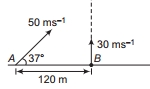
Balls $A$ and $B$ are thrown from two points lying on the same horizontal plane separated by a distance $120\,m$. Which of the following statement$(s)$ is/are correct.
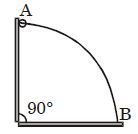
A wire, which passes through the hole in a small bead, is bent in the form of quarter of a circle. The wire is fixed vertically on ground as shown in the figure. The bead is released from near the top of the wire and it slides along the wire without friction. As the bead moves from $A$ to $B$, the force it applies on the wire is
A rigid body rotates about a fixed axis with variable angular velocity equal to $\alpha -\beta t$, where $t$ is time and $\alpha \,,\, \beta $ are constants. The angle (in radian) through which it rotates before its stops
The unit of permittivity of free space ${\varepsilon _0}$ is
$Assertion :$ In free expansion of an ideal gas, the entropy increases.
$Reason :$ Entropy increases in all natural processes.
A stone of mass $m$, tied to a string is being whirled in a vertical circle with a uniform speed. The tension in the string is
A gas consisting of a rigid diatomic molecules was initially under standard condition. Then, gas was compressed adiabatically to one$-$fifth of its initial volume. What will be the mean kinetic energy of a rotating molecule in the final state ?
Which of the following combinations has the dimension of electrical resistance ( ${ \varepsilon _0}$ is the permittivity of vacuum and ${\mu _0}$ is the permeability of vacuum) ?
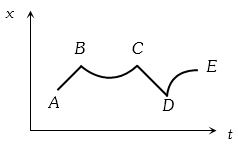
Figure shows the displacement of a particle going along the $X-$axis as a function of time. The force acting on the particle is zero in the region