An object suspended by a wire stretches it by $10 \,mm$. When object is immersed in a liquid the elongation in wire reduces by $\frac{10}{3} \,mm$. The ratio of relative densities of the object and liquid is $............$
Medium
Download our app for free and get started
$\Delta L=\frac{F L}{A Y}$ $\left\{\begin{array}{l}\text { Let density of liquid }=\rho \\ \text { Let density of object }=\sigma \\ \text { Mass of object }=M\end{array}\right.$
$\Rightarrow$ Elongation $\propto$ force and force is due to weight
So elongation $\propto$ weight
$\Delta L_1 \propto$ weight $\quad \ldots (1)$ When not submerged in liquid
$\Delta L_2 \propto$ apparant weight $\ldots .(2)$ When submerged in liquid
Dividing $(1)$ by $(2)$
$\frac{10}{10-\frac{10}{3}}=\frac{M g}{M g-\frac{M g \rho}{\sigma}}$
$\Rightarrow \frac{1}{1-\frac{1}{3}}=\frac{1}{1-\frac{\rho}{\sigma}}$
Solving this we get
$\frac{\rho}{\sigma}=\frac{1}{3}$
So relative densities of object $(\sigma)$ and liquid $(\rho)$ is $3: 1$
$\Rightarrow$ Elongation $\propto$ force and force is due to weight
So elongation $\propto$ weight
$\Delta L_1 \propto$ weight $\quad \ldots (1)$ When not submerged in liquid
$\Delta L_2 \propto$ apparant weight $\ldots .(2)$ When submerged in liquid
Dividing $(1)$ by $(2)$
$\frac{10}{10-\frac{10}{3}}=\frac{M g}{M g-\frac{M g \rho}{\sigma}}$
$\Rightarrow \frac{1}{1-\frac{1}{3}}=\frac{1}{1-\frac{\rho}{\sigma}}$
Solving this we get
$\frac{\rho}{\sigma}=\frac{1}{3}$
So relative densities of object $(\sigma)$ and liquid $(\rho)$ is $3: 1$

Download our appand get started for free
Experience the future of education. Simply download our apps or reach out to us for more information. Let's shape the future of learning together!No signup needed.*
Similar Questions
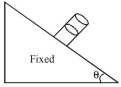
- 1A cylindrical vessel filled with water is released on an inclined surface of angle $\theta$ as shown in figure.The friction coefficient of surface with vessel is $\mu( < \tan \theta)$.Then the contact angle made by the surface of water with the incline will beView Solution
- 2The density of ice is $0.9 \,g / cm ^3$. What percentage by volume of the block of ice floats outside the water is ..........$\%$View Solution
- 3View SolutionA liquid disturbed by stirring comes to rest after some time due to its property of
- 4Water from a pipe is coming at a rate of $100\, litres$ per minute. If the radius of the pipe is $5\, cm$, the Reynolds number for the flow is of the order of : (density of water $= 1000\, kg/m^3$, coefficient of viscosity of water $= 1\, mPa\, s$)View Solution
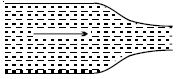
- 5Water flows through a frictionless duct with a cross-section varying as shown in figure. Pressure $p$ at points along the axis is represented byView Solution
- 6Which of the following is the incorrect graph for a sphere falling in a viscous liquid? (Given at $t = 0$, velocity $v = 0$ and displacement $x = 0$.)View Solution
- 7View SolutionAn ice cube contains a large air bubble. The cube is floating on the horizontal surface of water contained in a trough. What will happen to the water level, when the cube melts?
- 8View SolutionThe pressure at the bottom of a tank containing a liquid does not depend on
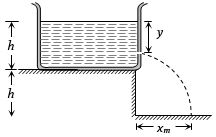
- 9A tank is filled upto a height $h$ with a liquid and is placed on a platform of height h from the ground. To get maximum range ${x_m}$ a small hole is punched at a distance of $y$ from the free surface of the liquid. ThenView Solution
- 10The vessel shown in the figure has two sections. The lower part is a rectangular vessel with area of cross-section $A$ and height $h$. The upper part is a conical vessel of height $h$ with base area $‘A’$ and top area $‘a’$ and the walls of the vessel are inclined at an angle $30^o$ with the vertical.A liquid of density $\rho$ fills both the sections upto a height $2h$. Neglecting atmospheric pressure.View Solution