MCQ
An object thrown vertically up from the ground passes the height $5 m$ twice in an interval of $10 s$. time of flight is ........ $s$
  • A
    $\sqrt{28}$
  • B
    $\sqrt{86}$
  • $\sqrt{104}$
  • D
    $\sqrt{72}$

Answer

Correct option: C.
$\sqrt{104}$
c
(c)

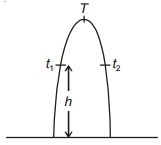
$h=5\, m \text { (given) }$

$t_2-t_1=10 \,s$

$T \rightarrow$ Time taken to reach the highest point.

$t_1=T-\sqrt{T^2-\frac{2 h}{g}}, t_2=T+\sqrt{T^2-\frac{2 h}{g}}$

$t_2-t_1=T+\sqrt{T^2-\frac{2 h}{g}}-T+\sqrt{T^2-\frac{2 h}{g}}$

$\Rightarrow 10=2 \sqrt{T^2-\frac{2 \times 5}{10}}$

$\Rightarrow 5=\sqrt{T^2-1} \Rightarrow 25=T^2-1$

$T^2=26$

$\Rightarrow T=\sqrt{26}$

$\text { Total time of flight } \Rightarrow 2 T=2 \sqrt{26}=\sqrt{4 \times 26}=\sqrt{104} \,s$
Need a full question paper?

Generate a complete, print-ready paper with questions like this in minutes — across 16+ boards, with answer keys.

Start Generating Free

Similar questions

The curve drawn between velocity and frequency of photon in vacuum will be a
The $r.m.s.$ speed of the molecules of a gas at a pressure ${10^5}$ $Pa$ and temperature $0^\circ C$ is $0.5km\;{\sec ^{ - 1}}.$ If the pressure is kept constant but temperature is raised to $819°C,$ the velocity will become ........ $km\,sec^{-1}$
A metallic body of material with density of $8000\  kg/m^3$ has a cavity inside. A spring balance shows its mass to be $10.0\  kg$ in air and $7.5\  kg$ when immersed in water. The ratio of the volume of the cavity to the volume of the material of the body must be
The displacement of a particle is proportional to the cube of time elapsed. How does the acceleration of the particle depends on time obtained
A tennis ball dropped from a height of $2 \,m$ rebounds only $1.5 \,m$ after hitting the ground. What fraction of its energy is lost in the impact
A wire of non-uniform cross-section is carrying a steady current. Along the wire
Two rods of equal mass $m$ and length $l$ lie along the $x$ axis and $y$ axis with their centres origin. What is the moment of inertia of both about the line $x=y$
A physical quantity of the dimensions of length that can be formed out of $c, G$ and $\frac{e^2}{4\pi \varepsilon _0}$  is $[c$ is velocity of light, $G$ is the universal constant of gravitation and $e$ is charge $] $
In case of an adiabatic process the correct relation in terms of pressure $p$ and density $\rho $ of a gas is
A double convex thin lens made of glass (refractive index $\mu  = 1.5$) has both radii of curvature of magnitude $20 cm$. Incident light rays parallel to the axis of the lens will converge at a distance $L$ such that......$cm$