An observer moves towards a stationary source of sound of frequency $n$. The apparent frequency heard by him is $2n$. If the velocity of sound in air is $332\, m/sec, $ then the velocity of the observer is .... $m/sec$
Medium
Download our app for free and get started
(c) $n' = n\,\left( {\frac{{v + {v_O}}}{v}} \right) $
$\Rightarrow 2n = n\,\left( {\frac{{v + {v_0}}}{v}} \right) $
$\Rightarrow \frac{{v + {v_0}}}{v} = 2$
$ \Rightarrow $ ${v_O} = v = 332 \,m/sec$

Download our appand get started for free
Experience the future of education. Simply download our apps or reach out to us for more information. Let's shape the future of learning together!No signup needed.*
Similar Questions
- 1Two interfering waves have the same wavelength, frequency, and amplitude. They are traveling in the same direction but are $90^o$ out of phase. Compared to the individual waves, the resultant wave will have the same.View Solution
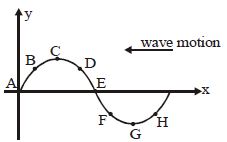
- 2View SolutionA transverse wave is travelling along a stretched string from right to left. The figure shown represents the shape of the string at a given instant. At this instant
- 3View SolutionWhen sound waves travel from air to water, which of the following remains constant
- 4Two engines pass each other moving in opposite directions with uniform speed of $30\,m/s$ . One of them is blowing a whistle of frequency $540\,Hz.$ Calculate the frequency heard by driver of second engine before they pass each other ... $Hz$. Speed of sound is $330\,m/sec$View Solution
- 5A man, standing between two cliffs, claps his hands and starts hearing a series of echoes at intervals of one second. If the speed of sound in air is $340 ms^{-1}$, the distance between the cliffs is .... $m$View Solution
- 6A motorcyclist is approaching a large wall with a velocity of $90\,km/hr$. A car is chasing him with a velocity of $108\,km/hr$. If the car sounds a horn at $30\,Hz,$ beat frequency heard by motorcyclist is ____ $Hz$ . Take velocity of sound $= 330\,m/s$ .View Solution
- 7An organ pipe of length $L$ is open at one end and closed at other end. The wavelengths of the three lowest resonating frequencies that can be produced by this pipe areView Solution
- 8In a large room, a person receives direct sound waves from a source $120$ metres away from him. He also receives waves from the same source which reach him, being reflected from the $25$ metre high ceiling at a point halfway between them. The two waves interfere constructively for wavelength ofView Solution
- 9A wave travelling along the $x-$axis is described by the equation $y\left( {x,t} \right) = 0.005cos\left( {\alpha x - \beta t} \right)$ If the wavelength and the time period of the wave are $0.08\ m$ and $2.0\ s$, respectively, then $\alpha$ and $\beta$ in appropriate units areView Solution
- 10A string of length $1\,\,m$ and linear mass density $0.01\,\,kgm^{-1}$ is stretched to a tension of $100\,\,N.$ When both ends of the string are fixed, the three lowest frequencies for standing wave are $f_1, f_2$ and $f_3$. When only one end of the string is fixed, the three lowest frequencies for standing wave are $n_1, n_2$ and $n_3$. ThenView Solution