In a large room, a person receives direct sound waves from a source $120$ metres away from him. He also receives waves from the same source which reach him, being reflected from the $25$ metre high ceiling at a point halfway between them. The two waves interfere constructively for wavelength of
Diffcult
Download our app for free and get started
(a) Let $S$ be source of sound and $P$ the person or listner.
The waves from $S$ reach point $P$ directly following the path $SMP$ and being reflected from the ceiling at point $A$ following the path $SAP$.
$M$ is mid-point of $SP$ (i.e. $SM = MP)$ and $\angle \,SMA = {90^o}$
Path difference between waves $\Delta x = SAP - SMP$
We have $SAP = SA + AP = 2(SA)$
$ = $$2\sqrt {[{{(SM)}^2} + {{(MA)}^2}]} = 2\sqrt {({{60}^2} + {{25}^2})} =130m$
$\therefore $ Path difference $= SAP -SMP = 130 - 120 = 10 m$
Path difference due to reflection from ceiling = $\frac{\lambda }{2}$
$\therefore $ Effective path difference $\Delta x = 10 + \frac{\lambda }{2}$
For constructive interference
$\Delta x = 10 + \frac{\lambda }{2} = n\lambda \Rightarrow (2n - 1)\frac{\lambda }{2} = 10(n = 1,\,\,2,\,\,3....)$
$\therefore $ Wavelength $\lambda = \frac{{2 \times 10}}{{(2n - 1)}} = \frac{{20}}{{2n - 1}}$.
The possible wavelength are ?$ = $$20,\,\,\frac{{20}}{3},\,\,\frac{{20}}{5}\,,\,\,\frac{{20}}{7}\,,\,\,\frac{{20}}{9}\,,$…..
$ = $ $20$$m$, $6.67$$m$, $4m,$$2.85\,m,$ $2.22$$m,$…..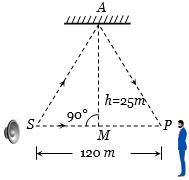

Download our appand get started for free
Experience the future of education. Simply download our apps or reach out to us for more information. Let's shape the future of learning together!No signup needed.*
Similar Questions
- 1A stretched string resonates with tuning fork frequency $512\; Hz$ when length of the string is $0.5\; m$. The length of the string required to vibrate resonantly with a tuning fork of frequency $256 \;Hz$ would be .......... $m$View Solution
- 2A person feels $2.5\%$ difference of frequency of a motor-car horn. If the motor-car is moving to the person and the velocity of sound is $320\, m/sec,$ then the velocity of car will beView Solution
- 3Ten tuning forks are arranged in increasing order of frequency in such a way that any two consecutive tuning forks produce $4$ beats per second. The highest frequency is twice that of the lowest. Possible highest and lowest frequencies (in $Hz$ ) are ................View Solution
- 4$A$ is singing a note and at the same time $B$ is singing a note with exactly one-eighth the frequency of the note of $A$. The energies of two sounds are equal, the amplitude of the note of $B$ isView Solution
- 5The frequency of a sonometer wire is $f$, but when the weights producing the tensions are completely immersed in water the frequency becomes $f/2$ and on immersing the weights in a certain liquid the frequency becomes $f/3$. The specific gravity of the liquid is:View Solution
- 6An observer starts moving with uniform acceleration $a$ toward a stationary sound source emitting a whistle of frequency $n.$ As the observer approaches source, the apparent frequency, heard by the observer varies with time asView Solution
- 7A tuning fork vibrating with a sonometer having $20\,cm$ wire produces $5$ beats per sec. The beat frequency does not change if the length of the wire is changed to $21\,cm$. The frequency of the tuning fork must be ..... $Hz$View Solution
- 8Two trains $A$ and $B$ are moving with speeds $20 \mathrm{~m} / \mathrm{s}$ and $30 \mathrm{~m} / \mathrm{s}$ respectively in the same direction on the same straight track, with $B$ ahead of $A$. The engines are at the front ends. The engine of train $A$ blows a long whistle.View Solution
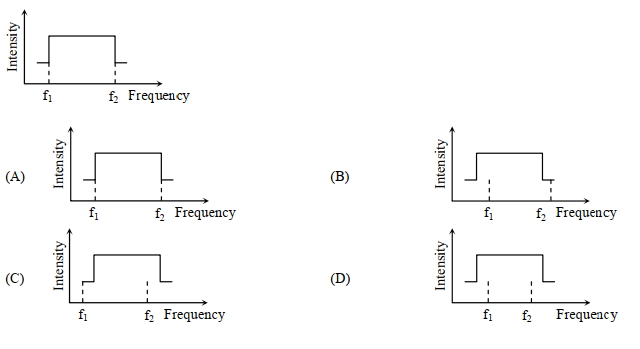
Assume that the sound of the whistle is composed of components varying in frequency from $f_1=800 \mathrm{~Hz}$ to $f_2=1120 \mathrm{~Hz}$, as shown in the figure. The spread in the frequency (highest frequency - lowest frequency) is thus $320 \mathrm{~Hz}$. The speed of sound in still air is $340 \mathrm{~m} / \mathrm{s}$.
$1.$ The speed of sound of the whistle is
$(A)$ $340 \mathrm{~m} / \mathrm{s}$ for passengers in $A$ and $310 \mathrm{~m} / \mathrm{s}$ for passengers in $B$
$(B)$ $360 \mathrm{~m} / \mathrm{s}$ for passengers in $A$ and $310 \mathrm{~m} / \mathrm{s}$ for passengers in $B$
$(C)$ $310 \mathrm{~m} / \mathrm{s}$ for passengers in $A$ and $360 \mathrm{~m} / \mathrm{s}$ for passengers in $B$
$(D)$ $340 \mathrm{~m} / \mathrm{s}$ for passengers in both the trains
$2.$ The distribution of the sound intensity of the whistle as observed by the passengers in train $\mathrm{A}$ is best represented by
$Image$
$3.$ The spread of frequency as observed by the passengers in train $B$ is
$(A)$ $310 \mathrm{~Hz}$ $(B)$ $330 \mathrm{~Hz}$ $(C)$ $350 \mathrm{~Hz}$ $(D)$ $290 \mathrm{~Hz}$
Give the answer question $1,2$ and $3.$
- 9The equation of a wave travelling on a string is $y = 4\sin \frac{\pi }{2}\left( {8t - \frac{x}{8}} \right)$. If $x$ and $y$ are in $cm,$ then velocity of wave isView Solution
- 10View SolutionMechanical wave (sound wave) in a gas is