An observer moves towards a stationary source of sound with a velocity one-fifth of the velocity of sound. The precentage change in the apparent frequency is ..... $\%$
Medium
Download our app for free and get started
When an observer moves towards a stationary source, the apparent frequency heard by the observer is
$\mathrm{v}^{\prime}=\mathrm{v}_{0}\left(\frac{\mathrm{v}+\mathrm{v}_{0}}{\mathrm{v}}\right)$
where
$\mathrm{v}_{0}=$ frequency fo the source
$\mathrm{v}_{0}=$ velocity of the observer
$\mathrm{v}=$ velocity of the sound
$\therefore $ $\mathrm{v}^{\prime}=\mathrm{v}_{0}\left(\frac{\mathrm{v}+\frac{\mathrm{v}}{5}}{\mathrm{v}}\right)=\frac{6 \mathrm{v}_{0}}{5}$
Percentage change in apparent frequency
$=\frac{v^{\prime}-v_{0}}{v_{0}} \times 100$
$=\frac{\left(\frac{6 v_{0}}{5}-v_{0}\right)}{v_{0}} \times 100=\frac{1}{5} \times 100=20 \%$

Download our appand get started for free
Experience the future of education. Simply download our apps or reach out to us for more information. Let's shape the future of learning together!No signup needed.*
Similar Questions
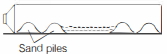
- 1A closed pipe of length $300 \,cm$ contains some sand. A speaker is connected at one of its ends. The frequency of the speaker at which the sand will arrange itself in $20$ equidistant piles is close to .......... $kHz$ (velocity of sound is $300 \,m / s )$View Solution
- 2View SolutionAt nodes in stationary waves
- 3A standing wave is formed by the superposition of two waves travelling in opposite directions. The transverse displacement is given by $y\left( {x,t} \right) = 0.5\sin\, \left( {\frac{{5\pi }}{4}x} \right)\,\cos\, \left( {200\,\pi t} \right)$. What is the speed of the travelling wave moving in the positive $x$ direction .... $m/s$ ? ($x$ and $t$ are in meter and second, respectively.)View Solution
- 4A source, approaching with speed $u$ towards the open end of a stationary pipe of length $L$, is emitting a sound of frequency $f_5$. The farther end of the pipe is closed. The speed of sound in air is $v$ and $f_0$ is the fundamental frequency of the pipe. For which of the following combination(s) of $u$ and $f_5$, will the sound reaching the pipe lead to a resonance?View Solution
$(A)$ $u=0.8 v$ and $f_5=f_0$
$(B)$ $u=0.8 v$ and $f_5=2 f_0$
$(C)$ $u=0.8 v$ and $f_5=0.5 f_0$
$(D)$ $u=0.5 v$ and $f_5=1.5 f_0$
- 5A standing wave having $3$ nodes and $2$ antinodes is formed between two atoms having a distance $1.21\;\mathring A$ between them. The wavelength of the standing wave is .... $\mathop A\limits^o $View Solution
- 6The superposing waves are represented by the following equations :${y_1} = 5\sin 2\pi (10\,t - 0.1x)$, ${y_2} = 10\sin 2\pi (20\,t - 0.2x)$ Ratio of intensities $\frac{{{I_{\max }}}}{{{I_{\min }}}}$ will beView Solution
- 7If $v$ is the speed of sound in air then the shortest length of the closed pipe which resonates to a frequency $n$View Solution
- 8Two sources of sound placed close to each other, are emitting progressive waves given by $ y_1=4sin\left( {600\pi t} \right)$ and $y_2=5sin\left( {608\pi t} \right)$ An observer located near these two sources of sound will hearView Solution
- 9View SolutionIf we study the vibration of a pipe open at both ends, then the following statement is not true.
- 10Tube $A$ has both ends open while tube $B$ has one end closed, otherwise they are identical. The ratio of fundamental frequency of tube $A$ and $B$ isView Solution