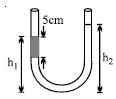
An open-ended $U$-tube of uniform cross-sectional area contains water (density $1.0 $ gram/centimeter$^3$) standing initially $20$ centimeters from the bottom in each arm. An immiscible liquid of density $4.0$ grams/ centimeter $^3$ is added to one arm until a layer $5$ centimeters high forms, as shown in the figure above. What is the ratio $h_2/h_1$ of the heights of the liquid in the two arms?
Diffcult
Download our app for free and get started
$h_{1}+h_{2}=20+20+5=45 \quad…………(I),$ since initially water was $20 \mathrm{cm}$ in each arm. since pressure at bottom of both the limbs is equal after adding the immiscible liquid,
we have
$5 \times 4 \times g+\left(h_{1}-5\right) \times 1 \times g=h_{2} \times 1 \times g$
$\Rightarrow h_{2}-h_{1}=15………..(I I)$
from $(I)$ and $(I I),$ we have
$h_{2}=30, h_{1}=15$
$\Rightarrow \frac{h_{2}}{h_{1}}=\frac{2}{1}$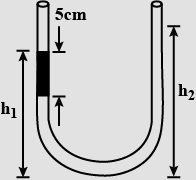

Download our appand get started for free
Experience the future of education. Simply download our apps or reach out to us for more information. Let's shape the future of learning together!No signup needed.*
Similar Questions
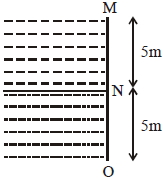
- 1Two liquids of densities $\rho_{1}$ and $\rho_{2}\left(\rho_{2}=2 \rho_{1}\right)$ are filled up behind a square wall of side $10\; \mathrm{m}$ as shown in figure. Each liquid has a height of $5 \;\mathrm{m} .$ The ratio of the forces due to these liquids exerted on upper part $MN$ to that at the lower pait $NO$ is (Assume that the liquids are not mixing)View Solution
- 2A ball of relative density $0.8$ falls into water from a height of $2$ $m$. The depth to which the ball will sink is ........ $ m$ (neglect viscous forces) :View Solution
- 3Two copper vessels $A$ and $B$ have the same base area but of different shapes. $A$ takes twice the volume of water as that $B$ requires to fill upto a particular common height. Then the correct statement among the following isView Solution
- 4The velocity of a small ball of mass $0.3\,g$ and density $8\,g / cc$ when dropped in a container filled with glycerine becomes constant after some time. If the density of glycerine is $1.3\,g / cc$, then the value of viscous force acting on the ball will be $x \times 10^{-4}\,N$, the value of $x$ is [use $g=10\,m / s ^{2}$ ]View Solution
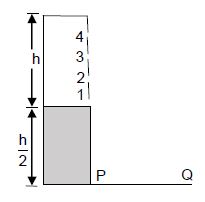
- 5A cylinder of height $h$ is filled with water and is kept on a block of height $h / 2$ . The level of water in the cylinder is kept constant. Four holes numbered $1, 2, 3$ and $4$ are at the side of the cylinder and at heights $0,\ h / 4,\ h / 2$ and $3h / 4$ respectively. When all four holes are opened together, the hole from which water will reach farthest distance on the plane $PQ$ is the hole numberView Solution
- 6A barometer is constructed using a liquid (density $\left.=760 \;kg / m ^{3}\right) .$ What would be the height (In $m$) of the liquid column, when a mercury barometer reads $76 \;cm ?$ (density of mercury $\left.=13600 \;kg / m ^{3}\right)$View Solution
- 7A vertical U-tube of uniform cross-section contains water in both the arms. A $10 \,cm$ glycerine column ($R.D$. $=1.2$ ) is added to one of the limbs. The level difference between the two free surfaces in the two limbs will be ...... $cm$View Solution
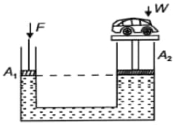
- 8In a hydraulic jack as shown, mass of the car $W=800 \,kg , A_1=10 \,cm ^2, A_2=10 \,m ^2$. The minimum force $F$ required to lift the car is ........... $N$View Solution
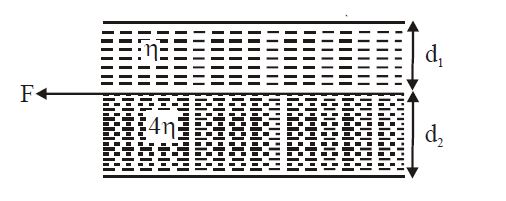
- 9A thin plate separates two liquids of coefficients of viscosity $\eta$ and $4\ \eta$ kept between two fixed plates as shown. If plate has to be pulled by applying minimum force then $\frac{d_2}{d_1}$ isView Solution
- 10An aeroplane of mass $3 \times 10^4\,kg$ and total wing area of $120\,m^2$ is in a level flight at some height. The difference in pressure between the upper and lower surfaces of its wings in kilopascals is........... $kPa$ $(g=10\,m/s^2)$View Solution