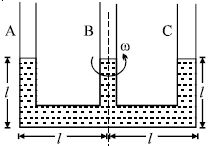
Figure shows a three arm tube in which a liquid is filled upto levels of height $l$. It is now rotated at an angular frequency $\omega$ about an axis passing through arm $B$. The angular frequency $\omega$ at which level of liquid in arm $B$ becomes zero.
Diffcult


Download our appand get started for free
Experience the future of education. Simply download our apps or reach out to us for more information. Let's shape the future of learning together!No signup needed.*
Similar Questions
- 1A liquid drop of mass $m$ and radius $r$ is falling from great height. Its velocity is proportional to ............View Solution
- 2View SolutionA large ship can float but a steel needle sinks because of
- 3A container of height $10\, cm$ is filled with water. There is a hole at bottom. Find the pressure difference between points at top and bottom.View Solution
- 4Force in Column - $\mathrm{I}$ and its use is in Column - $\mathrm{II}$ are given. Match them appropriately.View Solution
Column - $\mathrm{I}$ Column - $\mathrm{II}$ $(a)$ Cohesive force $(i)$ Useful for writing by chalk on blackboard. $(b)$ Adhesive force $(ii)$ Useful in soldering. $(iii)$Useful for formation of spherical drops of liquid. - 5View SolutionBernoulli's principle does not explain
- 6View SolutionFrom amongst the following curves, which one shows the variation of the velocity v with time t for a small sized spherical body falling vertically in a long column of a viscous liquid
- 7A cylindrical vessel filled with water upto height of $H$ stands on a horizontal plane. The side wall of the vessel has a plugged circular hole touching the bottom. The coefficient of friction between the bottom of vessel and plane is $\mu$ and total mass of water plus vessel is $M$. What should be minimum diameter of hole so that the vessel begins to move on the floor if plug is removed (here density of water is $\rho$ )View Solution
- 8A stream-lined body falls through air from a height $h$ on the surface of liquid. Let $d$ and $D$ denote the densities of the materials of the body and the liquid respectively. If $D > d$, then the time after which the body will be instantaneously at rest, isView Solution
- 9A ball of density $'\rho '$ is released from deep inside of a viscous liquid of density $'2\rho '$ . It will move upView Solution
- 10A ball whose density is $0.4 \times 10^3\,kg/m^3$ falls into water from a height of $9\,cm$ . To what depth does the ball sink ? ....... $cm$View Solution