Question
An optical instrument used for angular magnification has a 25D objective and a 20D eyepiece. The tube length is 25cm when the eye is least strained.
  1. Whether it is a microscope or a telescope?
  2. What is the angular magnification produced?

Answer

The optical instrument has

$\text{f}_0=\frac{1}{25\text{D}}=0.04\text{m}=4\text{cm}$

$\text{f}_\text{e}=\frac{1}{20\text{D}}=0.05\text{m}=5\text{cm}$

tube length = 25cm (normal adjustment)

  1. The instrument must be a microscope as f0 < fe
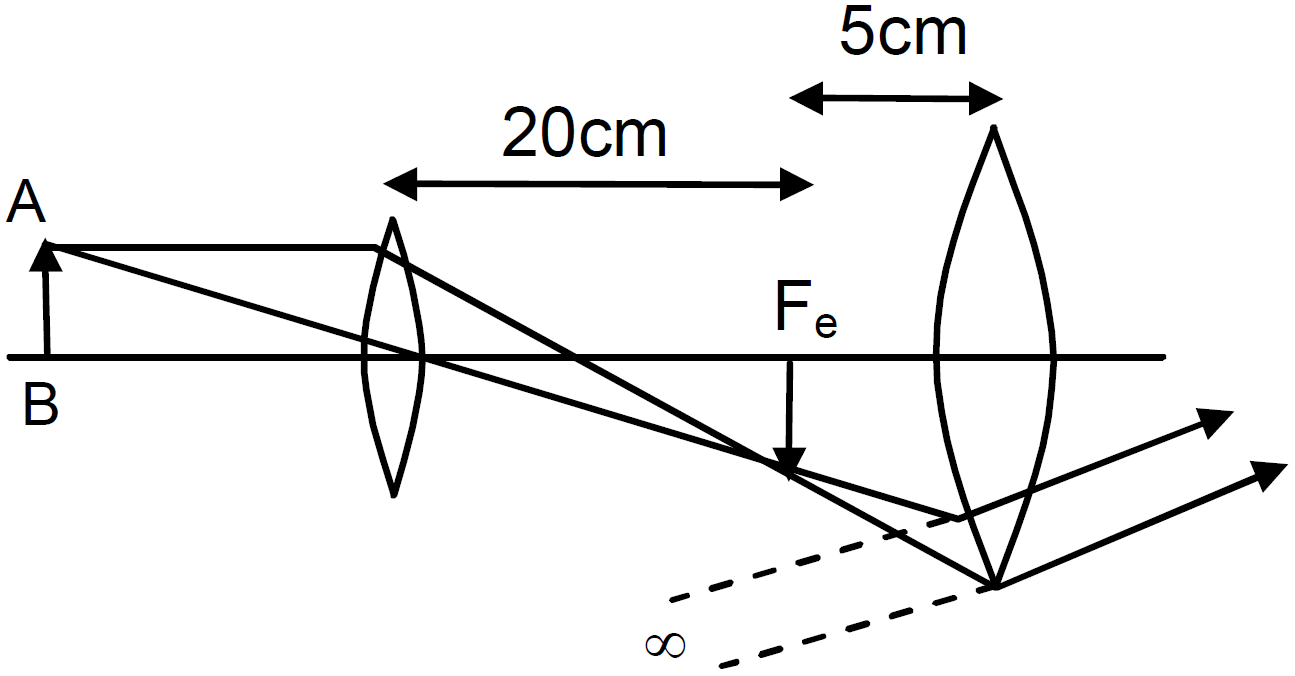
  2. Since the final image is formed at infinity, the image produced by the objective should lie on the focal plane of the eye piece.

So, image distance for objective = v0 = 25 – 5 = 20cm

Now, using lens formula.

$\frac{1}{\text{v}_0}-\frac{1}{\text{u}_0}=\frac{1}{\text{f}_0}$

$\Rightarrow\frac{1}{\text{u}_0}=\frac{1}{\text{v}_0}-\frac{1}{\text{f}_0}=\frac{1}{20}-\frac{1}{4}$

$=\frac{-4}{20}=\frac{-1}{5}\Rightarrow\text{u}_0=-5\text{cm}$

So, angular magnification $\text{m}=-\frac{\text{v}_0}{\text{u}_0}\times\frac{\text{D}}{\text{f}_\text{e}}$[Taking D = 25cm]

$=-\frac{20}{-5}\times\frac{25}{5}=20$
Need a full question paper?

Generate a complete, print-ready paper with questions like this in minutes — across 16+ boards, with answer keys.

Start Generating Free

Similar questions

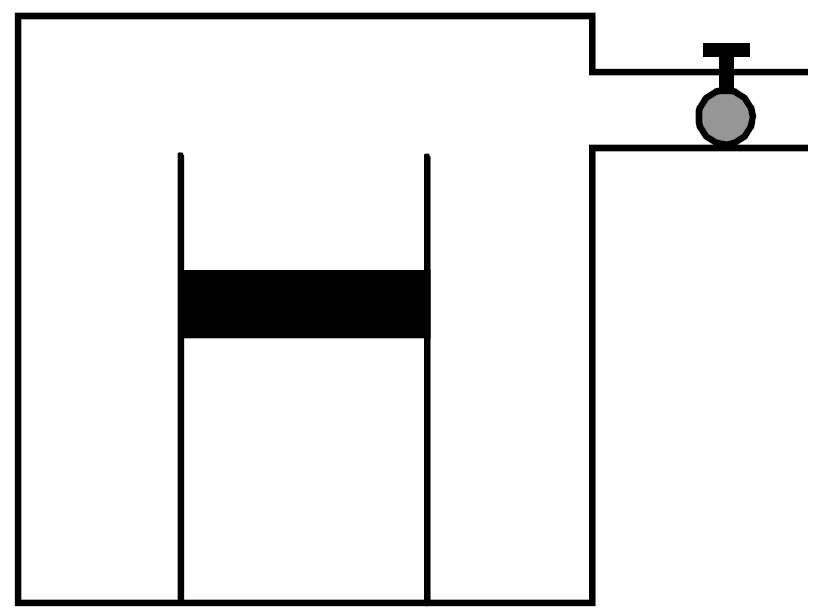
An ideal gas is kept in a long cylindrical vessel fitted with a frictionless piston of cross-sectional area 10cmand weight 1kg (figure.) The vessel itself is kept in a big chamber containing air at atmospheric pressure 100kPa. The length of the gas column is 20cm. If the chamber is now completely evacuated by an exhaust pump, what will be the length of the gas column? Assume the temperature to remain constant throughout the process.

Earth’s orbit is an ellipse with eccentricity 0.0167. Thus, earth’s distance from the sun and speed as it moves around the sun varies from day to day. This means that the length of the solar day is not constant through the year. Assume that earth’s spin axis is normal to its orbital plane and find out the length of the shortest and the longest day. A day should be taken from noon to noon. Does this explain variation of length of the day during the year?
What is the principle of superposition? On what factors frequency and amplitude of the resultant wave depend? What effect can be produced by the superposi- tion of two sound waves? Exaplain interference of sound wave and analyze it mathematically.
How much energy is radiated per minute from the filament of incandescent lamp at 3000K if the surface area is 10-4m2 and its emissivity is 0.4? Stefan's constant
 = 5.67 × 10-8 Wm-2K-4.
Two convex lenses, each of focal length 10cm, are placed at a separation of 15cm with their principal axes coinciding,
  1. Show that a light beam coming parallel to the principal axis diverges as it comes out of the lens system.
  2. Find the location of the virtual image formed by the lens system of an object placed far away.
  3. Find the focal length of the equivalent lens.
(Note that the sign of the focal length is positive although the lens system actually diverges a parallel beam incident on it).
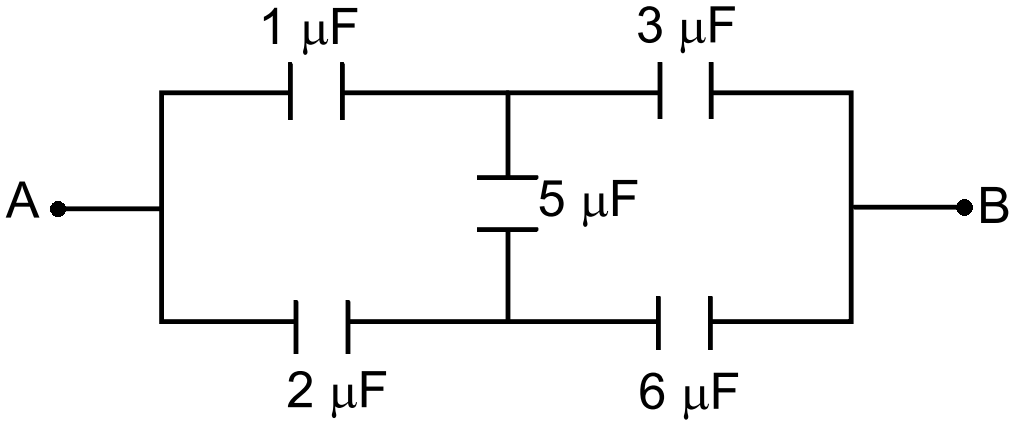
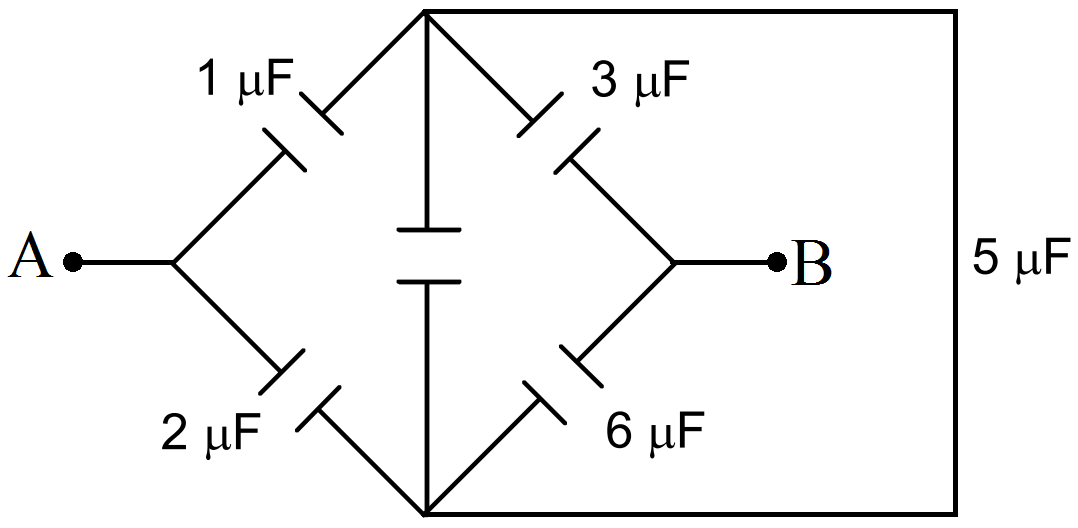
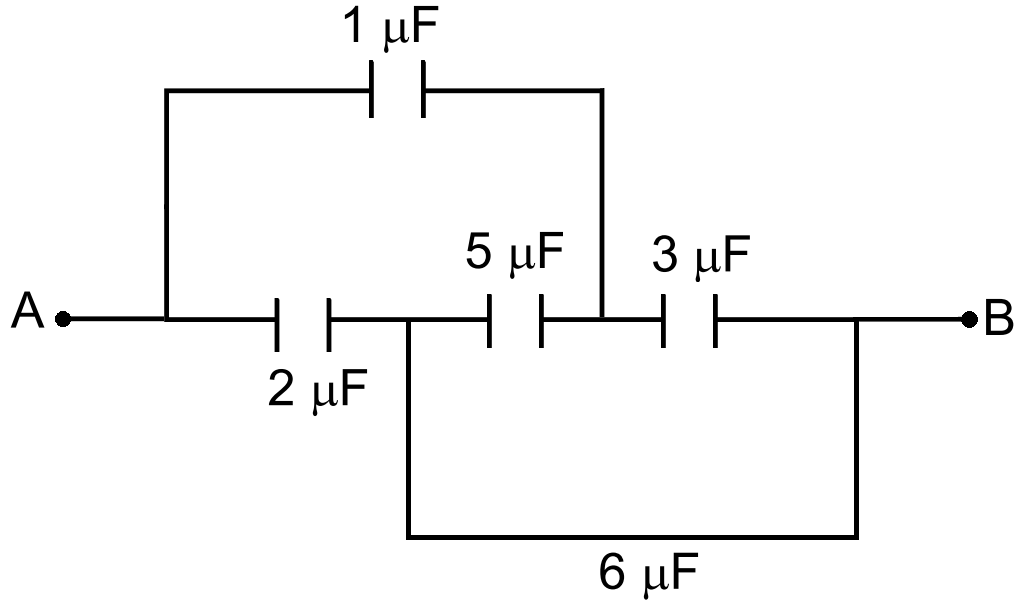
Convince yourself that parts (a), (b) and (c) of figure are identical. Find the capacitance between the points A and B of the assembly.


In nature, the failure of structural members usually result from large torque because of twisting or bending rather than due to tensile or compressive strains. This process of structural breakdown is called buckling and in cases of tall cylindrical structures like trees, the torque is caused by its own weight bending the structure. Thus the vertical through the centre of gravity does not fall within the base. The elastic torque caused because of this bending about the central axis of the tree is given by $\frac{\text{Y}\pi\text{r}^4}{4\text{R}}.$ Y is the Young’s modulus, r is the radius of the trunk and R is the radius of curvature of the bent surface along the height of the tree containing the centre of gravity (the neutral surface). Estimate the critical height of a tree for a given radius of the trunk.
Explain why
A spinning cricket ball in air does not follow a parabolic trajectory.
In a simple Atwood machine, two unequal masses m1 and m2 are connected by a string going over a clamped light smooth pulley. In a typical arrangement m1 = 300g and m2 = 600g. The system is released from rest.
  1. Find the distance travelled by the first block in the first two seconds.
  2. Find the tension in the string.
  3. Find the force exerted by the clamp on the pulley.

What is a thermometer? What things should be kept in mind while designing a thermometer? Explain to them.